

How Aipix Enables Adaptive ONVIF Camera Connectivity in Complex VSaaS Networks
When video surveillance is deployed on top of an existing provider or customer network, technical conflicts often arise. Standard ONVIF-based camera connection protocols do not work reliably in networks with NAT or complex routing.
As a result, technical teams at telecom providers often have to work more with network constraints than with the service itself:
- Network conflicts, such as overlapping IP addresses and ports when scaling to thousands of sites.
- Port forwarding complexity caused by NAT restrictions when a camera is located in an external or isolated network.
- Inefficient routing and no ability to choose the optimal traffic path, which leads to latency or unnecessary load on media servers.
Traditional video surveillance systems that use ONVIF require the network to be adjusted to their own requirements. This leads to IP address conflicts during scaling, port forwarding issues in isolated networks, and unnecessary complexity in system configuration and management.
Aipix changes this approach. The Aipix architecture now includes an adaptive model for connecting cameras via ONVIF. The platform no longer simply “polls” the device; it adapts to the topology of a specific communication node.
Aipix architecture applies an adaptive approach to working with network devices. We have implemented a flexible interaction model that adapts to the topology of a specific network, communication node, or site.
What Makes Aipix a Unique ONVIF Solution for Operators
1. Addressing Flexibility
The administrator can select the connection scheme and camera operation mode depending on the network architecture and traffic distribution requirements.
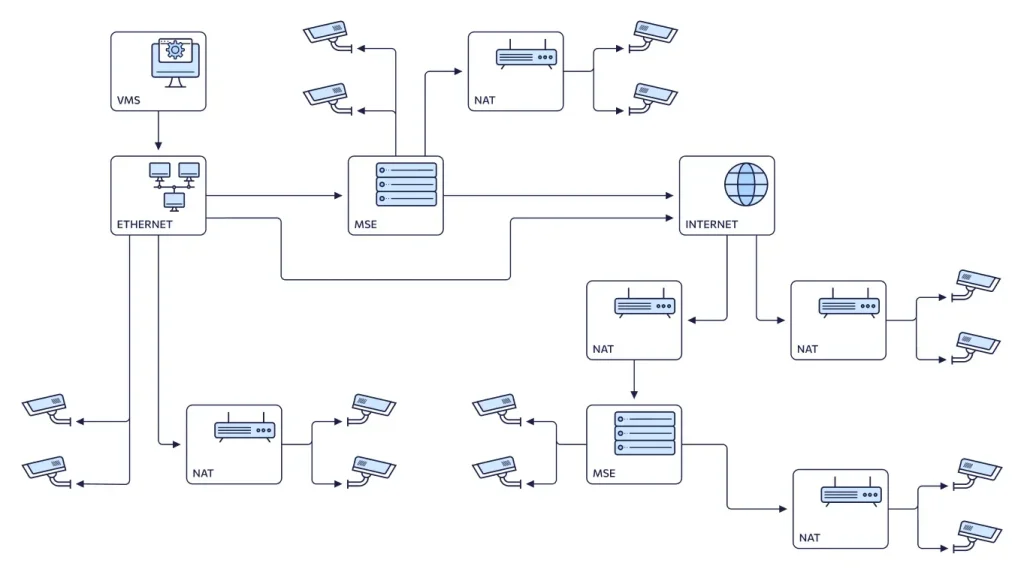
Internal Network
This scheme assumes that data and video transmission between the IP camera and platform components takes place over a network without Internet access, that is, an internal network. There are no NAT devices in front of the IP camera.
The IP camera network and the platform component network may be different, but routing must be configured between these networks. Only static IP addressing must be configured in the local network. Dynamic IP address allocation via DHCP is not allowed.
Internal Network (NAT Intranet)
This scheme assumes that data and video transmission between the IP camera and platform components takes place over a network without Internet access, that is, an internal network, but there is a NAT device in front of the IP camera.
The NAT device translates the private IP address of the IP camera, which is not available to platform components, into a static private IP address of the NAT device that is available to platform components.
External Network (NAT Internet)
This scheme should be selected when the camera is located in a remote network with access through the Internet.
In this case, there is a NAT device in front of the IP camera. The NAT device translates the private IP address of the IP camera, which is not available to platform components, into a static public IP address of the NAT device.
2. Video Stream Management: Direct vs Proxy
Aipix ONVIF connection supports different video data transmission modes depending on the required traffic path.
Direct
In Direct mode, the camera and the VMS controller exchange data directly, without intermediate servers.
All traffic, including control commands, ONVIF events, and the video stream, goes directly from the camera to the VMS controller. For ONVIF event subscriptions, the network address of the server running the VMS controller is used.
Proxy
In Proxy mode, interaction between the IP-camera and the VMS controller is handled through a media server.
The media server receives video streams and ONVIF events from the camera and forwards them to the VMS controller. The event server address, either internal or external IPv4, is selected automatically depending on the camera connection scheme.
3. Platform Adaptability
The platform adapts to the customer’s network topology instead of requiring the infrastructure to be reconfigured to meet VSaaS requirements.
Real-World Results for Telecom Operators and Internet Service Providers Running VSaaS
Implementing this operating logic simplifies the connection of new customers and the scaling of the VSaaS service.
1. Scalability
The number of incidents during new site onboarding is reduced. The system administrator can fine-tune the camera connection according to the specifics of a particular network.
2. Resource Optimization
Full control over network traffic distribution makes it possible to use media server capacity and data transmission channels more efficiently.
3. Reliability
The system becomes more reliable and more resilient to unstable network segments. It can maintain stable video stream reception even in complex routing conditions.
Adaptive ONVIF camera connectivity and operation implemented in the Aipix architecture is aimed to help telecom operators and Internet service providers reduce the technical complexity of VSaaS deployment in real network environments. By supporting different connection schemes, NAT scenarios, and Direct or Proxy traffic modes, Solução de software Aipix VSaaS allows the stable camera connectivity and management without network redesign needs. Get more details in the actual documentation.
For providers, this results in faster onboarding of new sites, fewer configuration incidents, better control over media server resources, and more reliable video stream delivery across distributed customer networks.
Want to simplify ONVIF camera connectivity and scale your VSaaS service without redesigning customer networks?
Get details how we in Aipix help telecom operators and ISPs deploy, manage, and scale video surveillance services across complex network environments via live-demo session. Fill the form for the free consultation




 PT
PT  EN
EN  ES
ES  FR
FR  PL
PL