
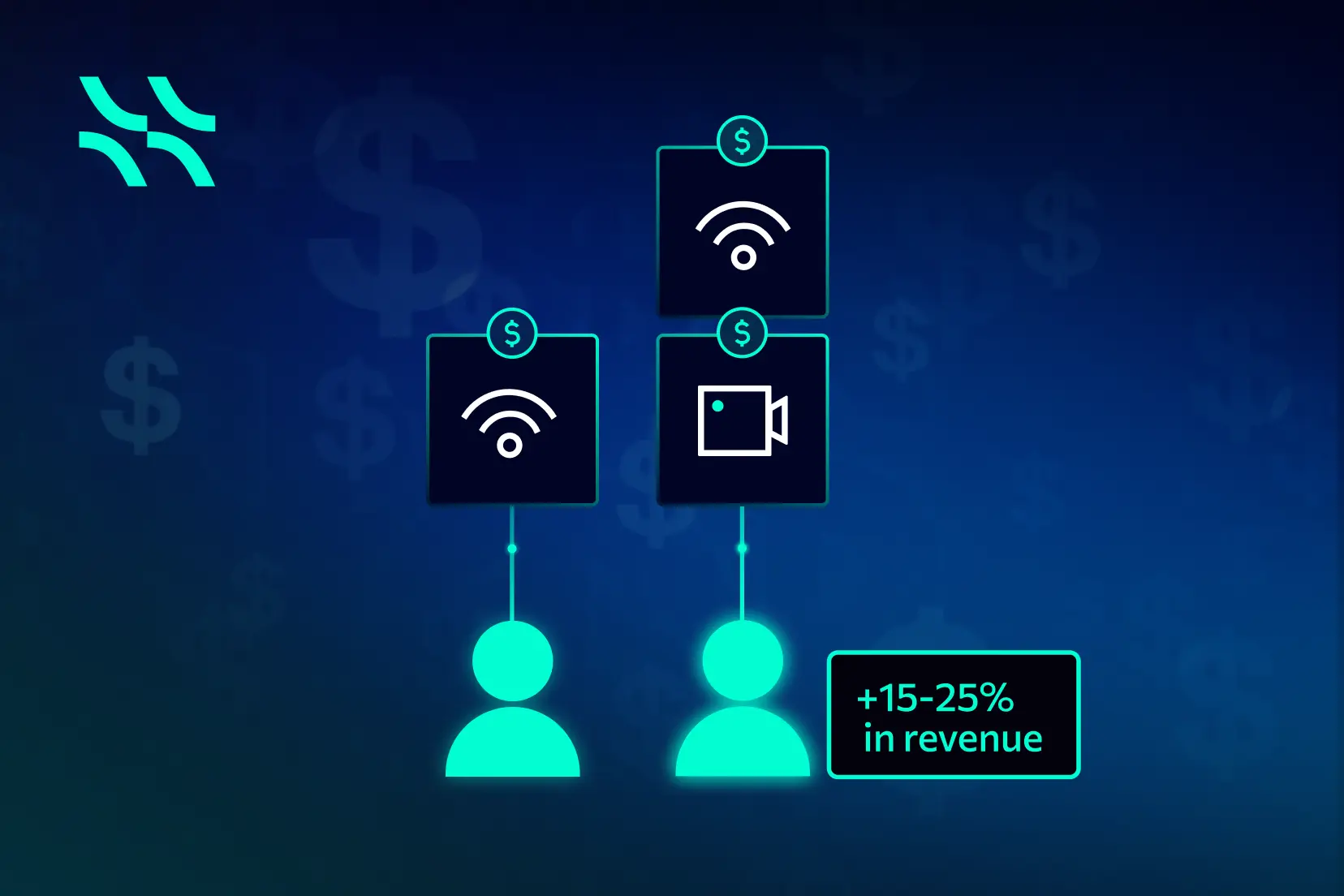
Telecom providers can increase broadband revenue by adding value-added services (VAS) to their existing connectivity packages. Their commercial contribution is already visible in operator results: in FY2026, digital services accounted for 26% of Vodafone Business service revenue, growing by 14.2% year over year (Vodafone FY2026 Results). Meanwhile, Simon-Kucher’s 2026 telecommunications research found that customers using converged services generate 7.5% higher broadband ARPU than customers without converged services (Simon-Kucher Global Telecommunications Study 2026). These results demonstrate the potential of expanding telecom service portfolios to increase revenue and extract more value from existing customer relationships.
For fixed broadband providers, cloud video surveillance and access control offer opportunities to apply this strategy. By introducing these solutions as standalone subscriptions or bundling them with internet plans, operators can generate additional recurring revenue from residential and business customers, increase ARPU, and differentiate their broadband offerings without relying exclusively on subscriber growth or connectivity price increases.
Why Value-Added Services Matter for Broadband Revenue
Fixed broadband remains an important and steadily growing telecommunications market. According to the International Telecommunication Union (ITU), global fixed broadband subscriptions grew by an average of 4.7% annually over the past five years, reaching 21 subscriptions per 100 inhabitants in 2026.
However, increasing subscriber numbers is not the only way for operators to grow their broadband business.
Expanding network coverage requires substantial capital investment, infrastructure development, and time. Meanwhile, increasing subscription prices can make providers less competitive, particularly in markets where customers can easily switch between internet service providers.
Traditional broadband subscriptions generate recurring revenue, but connectivity alone gives providers limited opportunities to differentiate their offers. Introducing complementary digital services allows operators to build additional paid packages around their existing infrastructure and customer base.
For example, telecom providers can offer:
- Residential customers: broadband combined with cloud video surveillance for remote home monitoring, live video access, and cloud recording.
- Business customers: internet connectivity bundled with cloud video surveillance and access control for premises monitoring and entry management.
This approach creates several commercial benefits:
- Higher ARPU: customers pay for additional services alongside their internet subscriptions.
- New recurring revenue: monthly service subscriptions provide revenue beyond basic connectivity.
- Differentiation: complementary digital solutions make broadband packages more distinctive.
- Customer retention: a broader service portfolio gives customers more reasons to maintain their relationship with the provider.
How Cloud Video Surveillance Helps Grow Recurring Revenue of Core Services
Cloud video surveillance (VSaaS) is one of the digital services telecom providers can introduce to their residential and business subscribers.
Instead of selling connectivity alone, operators can offer cloud-based video surveillance as an additional subscription or as part of a bundled broadband package.
For residential customers, this can include remote camera access, cloud video storage, and monitoring through a mobile application.
For business customers, the service can provide centralized camera management, remote access to video footage, and integration with video analytics.
The operator can monetize these capabilities through monthly subscriptions, additional cameras, storage options, and premium service packages.
Access control provides another opportunity to expand the portfolio. Smart intercoms, cloud-managed access systems, and mobile credentials can be offered as complementary services for residential buildings, offices, and commercial properties.
Together, these solutions allow broadband providers to build service packages around connectivity, security, and access management.
How Much Additional Revenue Can a Broadband Provider Generate?
Consider a hypothetical telecom operator with 500,000 fixed broadband subscribers and a popular internet plan priced at $10 per month.
The provider introduces an additional package: Internet + Cloud Video Surveillance, priced at $12 per month.
The difference is just $2 per month compared with the standard broadband subscription.
If 10% of existing subscribers upgrade to the new package, the operator gains 50,000 additional service subscriptions.
| Metric | Value |
|---|---|
| Existing broadband subscribers | 500,000 |
| Standard internet plan | $10/month |
| Bundled service price | $12/month |
| Additional monthly charge | $2 |
| Assumed adoption rate | 10% |
| Subscribers upgrading | 50,000 |
| Additional monthly revenue | $100,000 |
| Additional annualized revenue | $1,200,000 |
This represents $1.2 million in additional annualized revenue, assuming all 50,000 subscribers maintain the upgraded package for 12 months.
The calculation does not account for service delivery costs, infrastructure expenses, taxes, or customer acquisition and retention costs. It illustrates the revenue potential of introducing an additional paid service to an existing subscriber base.
The same model can be applied to business broadband packages, where providers can offer more advanced service combinations that include video surveillance, analytics, and access control.
What Telecom Providers Need to Launch Additional Digital Services
To make this model commercially viable, operators need a platform that allows them to launch, manage, and monetize services alongside their existing broadband offerings.
For cloud video surveillance and access control, this includes:
- Centralized service management: manage video surveillance and access control subscriptions through a unified platform.
- OSS/BSS integration: connect services with billing, CRM, and customer management systems to automate subscription and payment processes.
- Flexible service packages: create different offers for residential and business customers.
- White-label capabilities: deliver services under the telecom provider’s own brand.
- Scalable infrastructure: support growing numbers of subscribers, cameras, and connected devices.
A telecom-centric platform such as Viontel (formerly Aipix) enables service providers to build and manage cloud video surveillance and other cloud-based physical security services as part of their digital service portfolio.
This allows operators to extend their existing broadband business with additional services without developing an entirely new service infrastructure from scratch.
Increase Broadband Revenue by Creating More Value from Every Connection
Increasing broadband revenue does not have to depend exclusively on acquiring new subscribers, expanding network coverage, or raising internet prices.
By adding complementary digital services such as cloud video surveillance and access control, telecom providers can create new recurring revenue streams from their existing customer base, increase ARPU, and differentiate their broadband offerings.
The commercial opportunity lies in moving beyond connectivity alone and building a broader portfolio of services that customers are willing to pay for.
Growth is not just about connecting more subscribers. It is also about generating more value from every connection.




 EN
 ES
 FR
 PL
 PT