

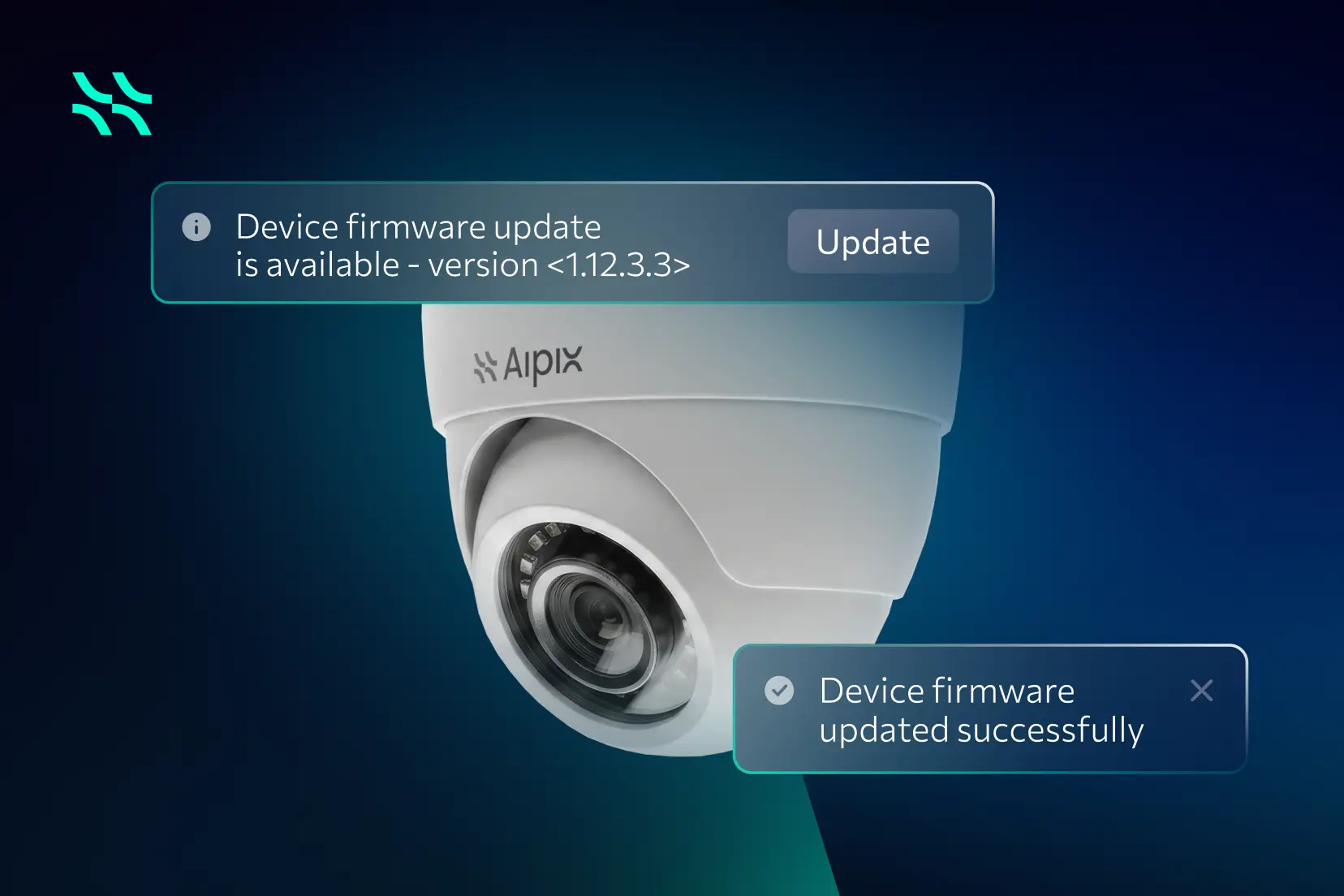
When maintaining cloud video surveillance service, the availability of OTA firmware update can play a great role of making the process more efficient especially in terms of technical specialist allocation. Launching a video surveillance service for subscribers is not only about getting the platform up and running. Once the service is live, telecom operators also need to maintain the devices installed at customer locations, keep their software up to date, and respond to technical issues — often across hundreds or thousands of geographically distributed sites.
This is where device management can become a significant operational challenge.
At Aipix, we addressed the deployment side by creating devices with our software pre-installed, allowing providers to introduce Aipix-based services at the customer side without complicated installation and configuration. The OTA updates are available for:
- Aipix Bridge – a quick connection to the video surveillance service for subscribers who already have cameras installed.
- The Aipix camera with the pre‑installed Agent is a ready‑made solution for subscribers who are just starting to use VSaaS and want to connect a camera without complex setup.
But fast deployment is only part of the equation. The next step is making ongoing device maintenance just as simple.
Why device maintenance matters for VSaaS?
In a traditional deployment model, updating device firmware may require physical access to the equipment. For a small number of subscribers, this might be manageable. But as a telecom operator scales its VSaaS offering, the number of customer-side devices grows as well.
A firmware update that takes a few minutes on one device can become a much larger operational task when engineers have to visit multiple customer locations.
This creates additional costs, scheduling challenges and workload for technical teams. It can also slow down the rollout of improvements to the service.
For a scalable VSaaS business, the question is therefore not only “How quickly can we deploy the device?”, but also “How efficiently can we maintain it after deployment?”
How to add new features to devices software when introduced in VSaaS solution without an on-site visit? OTA update is an answer
Over-the-Air (OTA) technology provides a way to handle firmware updates remotely.
With OTA, supported Aipix devices can receive new firmware without requiring an engineer to physically access the equipment. The update process can be managed remotely, allowing operators to keep devices aligned with the required software versions as the service evolves.
Instead of:
New firmware → technician visit → manual update → device back in operation
the process can become:
New firmware → remote deployment → device updated
This is particularly valuable for telecom operators with a large and geographically distributed subscriber base.
How OTA update of device firmware work in Aipix solution?
The process designed around controlled firmware management rather than indiscriminate updates across the entire device fleet.
The operator’s technical team — or the subscriber, where applicable — has control over the firmware repository and can determine when an update required.
A new firmware version can be introduced to a selected group of devices first. This makes it possible to validate the update under real operating conditions before expanding deployment.
Once the version successfully tested, technical specialist can roll out it to a wider group of devices.
This staged approach is important for operators because remote does not have to mean uncontrolled.
The technical team can decide which firmware version to use, which devices should receive it, and when the update should take place.
From one device to an entire subscriber base with OTA update
Consider an operator that has already launched cloud video surveillance for several hundred subscribers.
A new firmware version becomes available with improvements required for the current service environment.
Without remote updates, the operator may need to organize maintenance activities across multiple customer locations. The larger the subscriber base becomes, the more difficult this approach is to scale.
With OTA, the operator can take a different approach.
First, the new firmware can be tested on a limited number of devices. If everything works as expected, the update can be extended to additional subscribers.
The same process can then be repeated as the service grows.
This creates a more manageable relationship between subscriber growth and technical workload: adding more customers does not necessarily mean creating the same increase in field maintenance activities.
What OTA update changes for video surveillance service delivery by telecom operators?
The business value of OTA is closely connected to operational efficiency.
Fewer on-site interventions
Firmware maintenance no longer has to mean physical access to the equipment. OTA updates allow firmware to be updated remotely, so technical teams can manage supported devices without sending an engineer to the subscriber’s location.
For an operator managing a growing number of devices across different subscriber locations, this changes the economics of routine maintenance. Firmware updates can be handled through the platform instead of becoming a separate field-service task.
This is particularly relevant for geographically distributed deployments, where even a simple firmware update can otherwise require scheduling, travel and on-site intervention.
More consistent device management
Aipix provides administrators with control over the firmware repository. This means firmware management becomes part of the same centralized environment used to administer the devices and the VSaaS service.
The practical advantage is greater consistency across the device fleet: operators can control which firmware versions are available and apply the required version to selected devices rather than relying on individual manual updates.
Controlled rollout of updates
One of the most important parts of Aipix’s OTA implementation is that remote updates are not designed as an all-at-once operation.
Administrators can initiate firmware updates for selected devices, while the OTA functionality includes a phased rollout mechanism with support for A/B testing. Administrators can gradually enable access to a new firmware version for selected users instead of releasing it to the entire device base simultaneously.
This gives operators a much more controlled way to introduce new firmware:
New firmware → selected devices/users → real-world validation → wider rollout
For a telecom operator, this matters because the first deployment group can serve as a practical pilot. The firmware can be tested on real customer-side equipment and in real network conditions before the operator expands availability.
Lower risk during updates
A phased approach also helps reduce the potential impact of a problematic firmware release.
Rather than exposing the entire devices fleet to a new version immediately, an administrator can first make it available to a limited group and evaluate its operation. Aipix describes this as pilot testing in real-world operating environments, helping minimize risks and support system stability before a full-scale rollout.
This is especially useful for operators running VSaaS as a commercial service. The larger the subscriber base, the more important it becomes to have a controlled mechanism for introducing changes to customer-side equipment.
OTA therefore provides not only remote access to firmware updates, but also a mechanism for managing how those updates are introduced.
Easier service evolution
VSaaS is continuously developing: platforms receive new functionality, device capabilities can expand, and the way devices interact with the service can change over time.
OTA creates a practical mechanism for keeping the device side aligned with that evolution.
Instead of treating every firmware release as a separate maintenance project, operators have a remote mechanism for introducing new firmware, testing it with selected users or devices, and then expanding deployment when appropriate.
For a growing VSaaS business, this is important because scaling the service should not mean scaling manual device maintenance at the same rate.
What benefits does OTA update presents for subscribers?
For subscribers, the benefit is less visible — but equally important. They do not need to arrange a technician visit simply because their device requires a firmware update. Depending on the deployment configuration, the update can be initiated remotely with minimal user involvement.
That means fewer technical interruptions and less time spent dealing with device maintenance.
Instead of thinking about firmware versions, configurations and technical visits, subscribers can simply continue using their video surveillance service.
Deployment is only half of the story
For telecom operators entering the VSaaS market, the ability to deploy equipment quickly is important. But long-term operational efficiency is what makes the model scalable.
That’s why Aipix approaches device deployment and maintenance as parts of the same process.
Pre-installed software helps simplify deployment. OTA helps simplify what comes next.
Together, these capabilities can reduce the amount of manual work required at customer locations and give operators greater control over the devices supporting their VSaaS offering.
The result is a simpler operational model: deploy devices faster, maintain them remotely, introduce firmware updates in a controlled way, and keep the service ready to evolve.
For operators looking to launch and scale cloud video surveillance without turning device maintenance into a growing field-service operation, OTA is an important part of the equation.
If you want to learn more about how the OTA updates in Aipix device ecosystem works, contact us





 EN
EN  ES
ES  FR
FR  PL
PL  PT
PT