

ONVIF à grande échelle. Pourquoi la vidéosurveillance en tant que service devient un point noir pour les opérateurs télécoms et comment Aipix Edge y remédie.
Comment la nouvelle mise à jour Aipix Edge simplifie la vidéosurveillance à grande échelle
Pour la plupart Opérateurs de télécommunications et fournisseurs d'accès Internet, la vidéosurveillance en tant que service Sur le papier, cela paraît simple. Les caméras sont standardisées, ONVIF promet l'interopérabilité et le VSaaS semble être une extension logique des services de connectivité existants.
En réalité, cela peut s'avérer complexe. La gestion opérationnelle des systèmes de surveillance est confrontée à des défis importants, car les activités de déploiement ont dépassé leurs capacités. phase de test pilote initiale. Le processus d'intégration des caméras prend plus de temps que prévu. Les installations varient d'un site à l'autre. Les équipes d'assistance doivent résoudre des erreurs de configuration qui auraient pu être évitées.
Et malgré les investissements dans des caméras ONVIF modernes, bon nombre de leurs fonctionnalités avancées restent inutilisées car leur activation est trop complexe ou trop fragile à grande échelle.
C'est exactement le écart Mise à jour Aipix 25.12 est conçu pour fermere.
Le coût caché des déploiements ONVIF “ standard ”
ONVIF était censé simplifier l'intégration. Mais pour les fournisseurs de services, il introduit souvent une autre forme de complexité.
L'installation de chaque nouvelle caméra exige des utilisateurs la saisie manuelle de paramètres et la vérification des adresses réseau et des ports de communication avant même de résoudre les problèmes de connectivité. Les coûts d'exploitation deviennent considérables lorsqu'on les multiplie par le nombre important de points de terminaison, qui se comptent par centaines voire par milliers. Les ingénieurs consacrent leur temps à leurs tâches habituelles au lieu de se concentrer sur l'expansion du service. Les équipes de support doivent gérer les erreurs évitables commises lors de leurs interventions. Le processus de génération de revenus est plus long que prévu initialement.
Avec la nouvelle mise à jour de la plateforme Aipix VSaaS, l'intégration des caméras devient prévisible.
Dans l'application web Aipix, les opérateurs sélectionnent une caméra parmi les périphériques ONVIF détectés. Le système renseigne automatiquement tous les paramètres critiques. La caméra s'active une fois les informations vérifiées. Une configuration manuelle complète est disponible pour les environnements réseau complexes, mais son utilisation est facultative.
Le résultat est simple mais puissant : moins d'actions routinières, moins d'erreurs et une activation de service plus rapide pour tous.
Quand les caméras sont intelligentes, mais que la plateforme ne l'est pas. Aipix change la donne.
Une autre source de frustration fréquente pour les dirigeants des opérateurs télécoms et des fournisseurs d'accès à Internet est de devoir investir dans du matériel de caméra de pointe, puis de ne pas parvenir à le rentabiliser.
La plupart des caméras ONVIF intègrent une intelligence artificielle. Celle-ci permet aux utilisateurs de contrôler les fonctions PTZ, de détecter les mouvements et de recevoir des alertes en cas de tentative de sabotage ou d'événements de configuration. Ces fonctionnalités, présentes dans les solutions VSaaS, restent désactivées dans la plupart des déploiements, car leur gestion nécessite des outils supplémentaires distincts. Cela réduit donc la valeur ajoutée que vous pouvez offrir à vos clients.
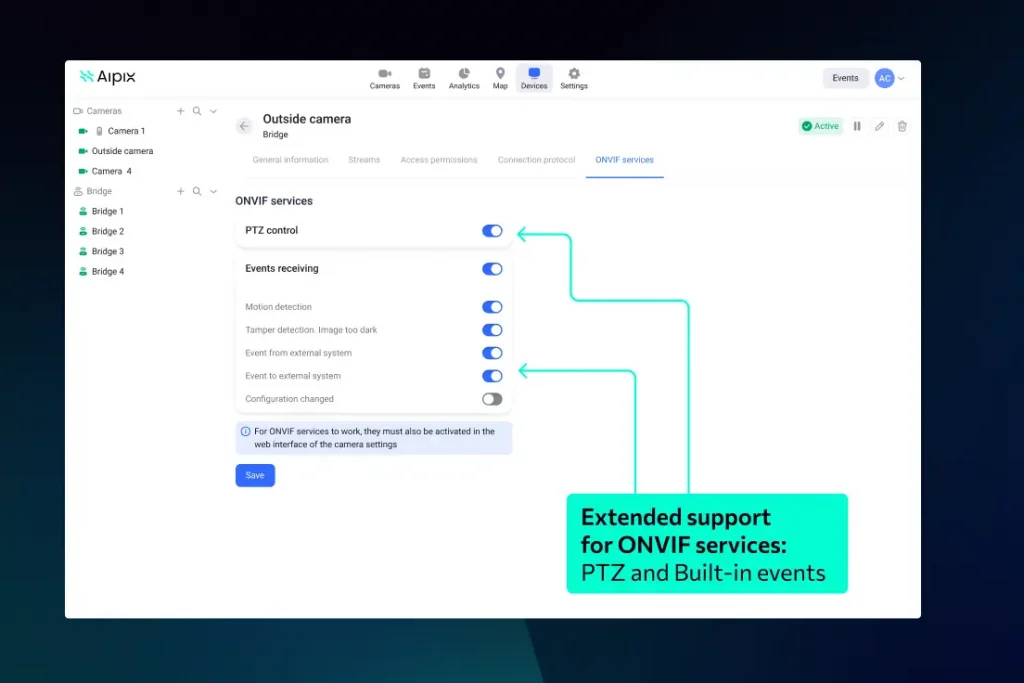
Aipix Edge intègre désormais des services ONVIF étendus directement dans sa plateforme.
Les caméras PTZ peuvent être contrôlées de manière interactive depuis l'application Web, permettant aux opérateurs ou aux utilisateurs finaux d'ajuster instantanément les angles de vue sans logiciel supplémentaire. Le système permet aux opérateurs de sélectionner les événements importants grâce au traitement intégré des événements de la caméra, tout en ignorant les événements non pertinents grâce à une solution de développement simple.
Le système intelligent intégré à la caméra permet aux prestataires de services d'offrir de meilleurs services sans générer de difficultés opérationnelles.
Une caméra, des besoins différents. Sans reconfiguration fastidieuse.
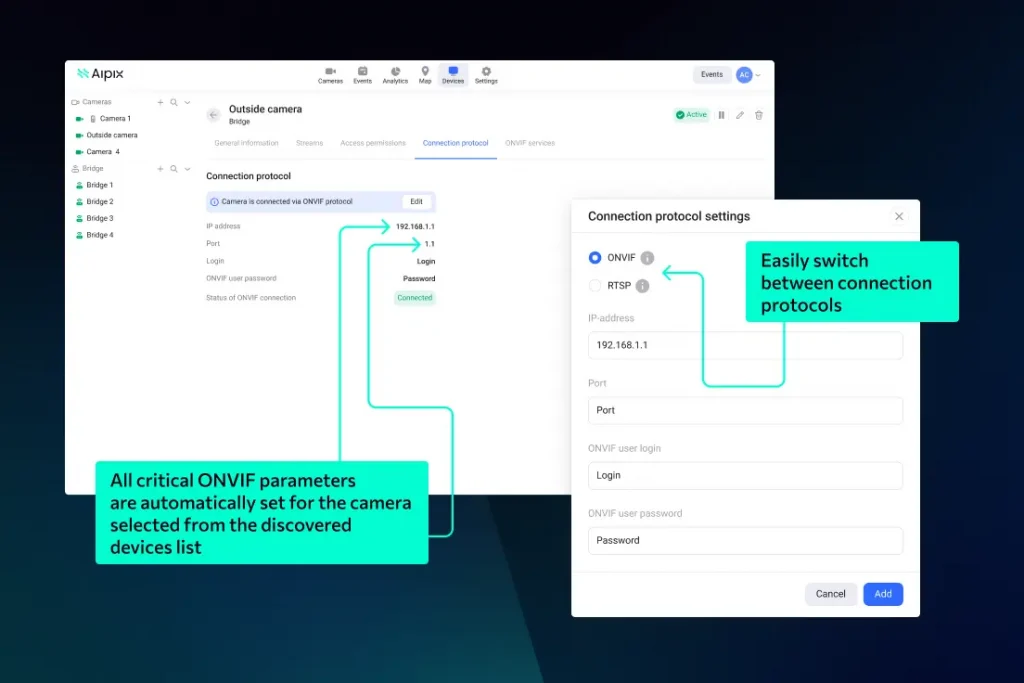
Dans la réalité, toutes les caméras n'ont pas besoin du même niveau de contrôle.
La méthode de déploiement fonctionne correctement avec la technologie de diffusion RTSP traditionnelle. Le système nécessite une intégration ONVIF avancée pour activer ses fonctionnalités intelligentes. Le passage d'une méthode à l'autre oblige les utilisateurs à reconfigurer les caméras, entraîne une interruption de service ou peut nécessiter une réinstallation complète du système de caméras.
Grâce à la dernière mise à jour d'Aipix, les opérateurs peuvent basculer instantanément entre les connexions RTSP et ONVIF. Aipix permet aux équipes de choisir la solution la plus adaptée à chaque caméra et à chaque clientèle, sans les contraindre à adopter une méthode unique. Ainsi, la direction bénéficie de cette fonctionnalité qui réduit son exposition aux risques et lui permet de prendre des décisions rapides grâce à une plateforme flexible qui s'adapte à l'évolution des besoins des clients.
Pourquoi la vidéosurveillance est importante au niveau de l'entreprise
Ce qui rend ONVIF difficile à mettre en œuvre pour les opérateurs télécoms, ce n'est pas la technologie, c'est l'échelle.
Chaque étape manuelle supplémentaire, chaque solution de contournement pour l'intégration et chaque fonctionnalité inutilisée de la caméra impactent directement les marges. Le VSaaS fonctionne avec des processus inefficaces qui limitent son potentiel d'expansion et sa capacité à réussir face à la concurrence.
La Mise à jour Aipix 25.12 Cette solution relève ces défis en rendant ONVIF prévisible, gérable et commercialement viable à grande échelle. Au final, la plateforme de surveillance bénéficie d'une croissance grâce à des processus d'inscription utilisateur rapides, une optimisation des fonctionnalités des caméras et de multiples options de connexion.
Prêt à transformer ONVIF d'un centre de coûts en un moteur de croissance des télécommunications ?
Si votre stratégie VSaaS est freinée par des difficultés d'intégration, des fonctionnalités de caméra sous-utilisées ou une complexité opérationnelle, il est temps de repenser la gestion d'ONVIF.
Découvrez les nouvelles fonctionnalités ONVIF d'Aipix dans la version 25.12 et voyez comment les opérateurs télécoms et les fournisseurs d'accès Internet simplifient la surveillance tout en augmentant la valeur du service.





 FR
FR  EN
EN  ES
ES  PL
PL  PT
PT