


Telecom operators and internet service providers have invested heavily in building strong infrastructure, despite these efforts, a significant telecom monetization gap remains.
According to GSMA, global telecom operator revenues grew by only about 1–2% annually in recent years, while data traffic has surged by over 30% year-on-year, highlighting a widening disconnect between usage and revenue.
Similarly, research from McKinsey & Company indicates that operators capture less than 10% of the total digital services revenue pool, with most value shifting to over-the-top platforms.
In today’s digital landscape, customer demand for advanced solutions is rapidly increasing, and simply raising internet tariffs is no longer enough. To unlock new revenue, operators must focus on delivering additional value through services.
The Growing Telecom Monetization Gap: Usage and Revenue Difference
According to PwC’s Global Telecom Outlook, global telecom service revenues are expected to rise from around $1.15 trillion in 2024 to $1.32 trillion by 2029. This equates to a modest CAGR of 2.8%, indicating stability but limited growth.
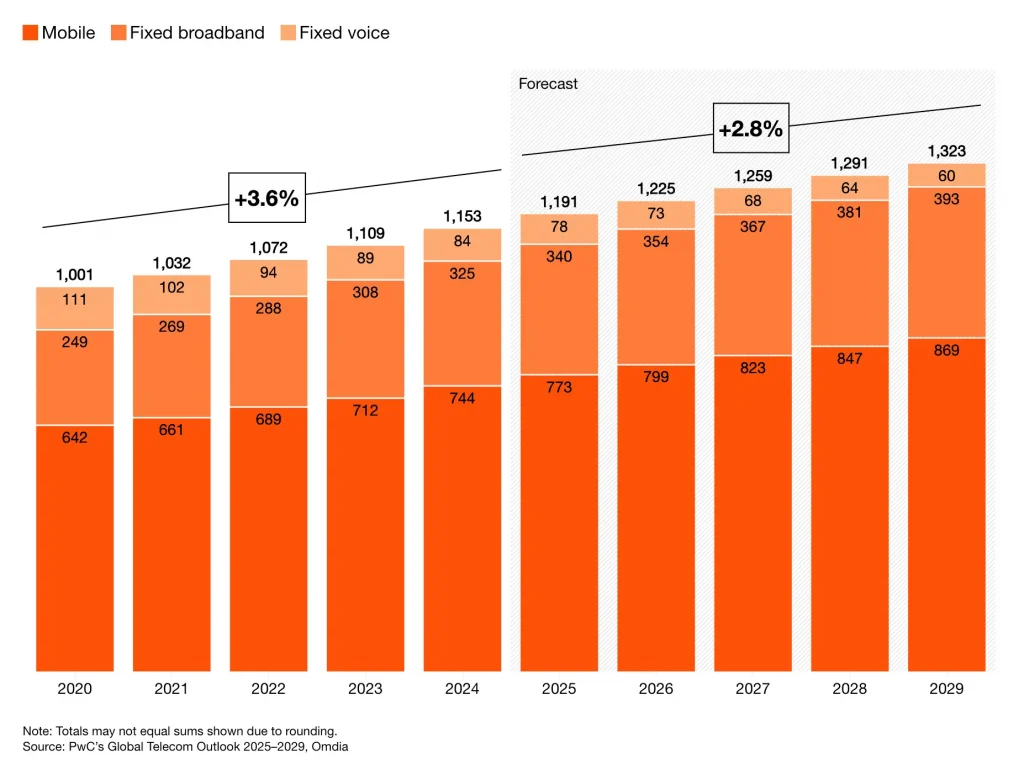
At the same time, network usage is expanding much faster. OTT platforms, cloud providers, streaming services, and security solutions all rely heavily on telecom infrastructure, yet their revenues are growing. But telecom revenues slowed down a bit. This imbalance is a key contributor to the monetization gap.
The ARPU Challenge
Average revenue per user (ARPU), a key performance indicator in telecom, is either stagnating or declining:
- Global mobile ARPU is projected to decrease slightly from $6.32 in 2024 to $6.20 by 2029
- Fixed broadband ARPU has grown only marginally, reaching $19.81 in 2024 compared to $19.73 in 2023
- Falling fixed voice revenues continue to drag down overall ARPU
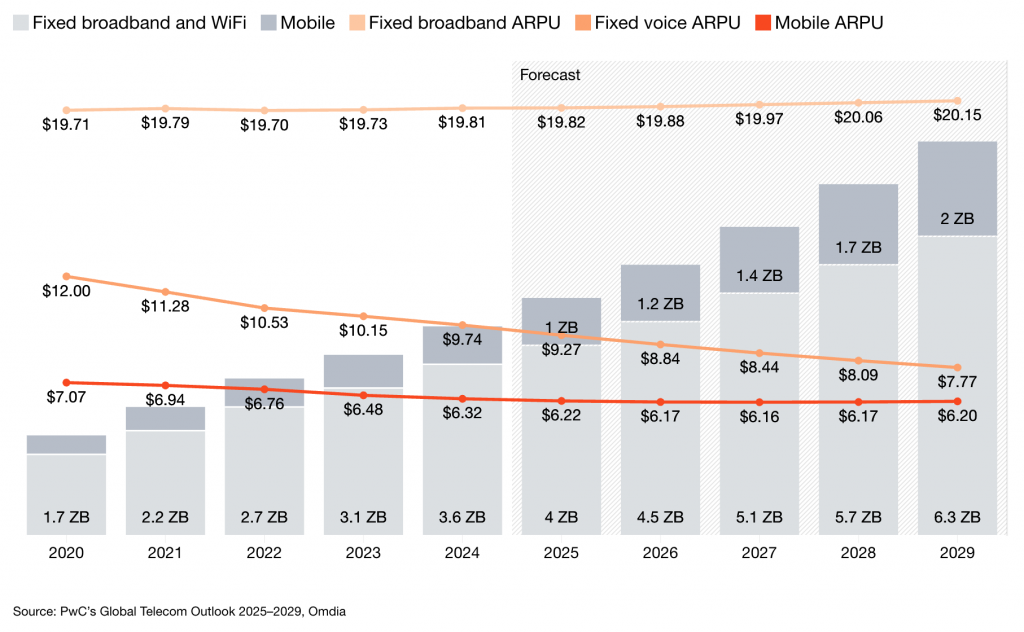
These trends highlight a shift in consumer expectations: users demand more data and better services but are increasingly unwilling to pay higher prices. The result is a structural imbalance – rapid growth in demand paired with flat or declining revenue.
The Role of Value-Added Services in Bridging Telecom Monetization Gap
To address the monetisation gap, telecom operators must expand beyond basic connectivity and adopt value-added services (VAS). These services allow operators to leverage existing infrastructure to generate additional income without significant new investments.
One of the most promising areas within VAS is Video Surveillance as a Service (VSaaS).
Why VSaaS Stands Out
VSaaS launched based on Aipix platform offers several compelling benefits:
- Fast monetisation: services can be launched quickly using existing networks
- Recurring revenue: subscription models ensure predictable income streams
- Strong demand: growing need for security, monitoring, and smart home solutions across both residential and business segments
- Scalability: cloud-based delivery allows rapid expansion without heavy capital expenditure
VSaaS effectively transforms telecom networks from passive connectivity providers into active digital service platforms.
Aipix: Simplifying VSaaS Launch and Shrink Telecom Monetisation Gap
Aipix enables telecom operators to unlock new revenue streams without disrupting their existing operations. It addresses common barriers to innovation, including complex integrations, high upfront costs, long deployment timelines, and operational challenges.
Core Approach. Aipix provides a plug-and-monetise platform that allows operators to quickly launch and scale services such as video surveillance, video analytics, smart intercom systems, and keyless access solutions. Key benefits:
- No need for upfront infrastructure investment
- On-premise deployment ensures control and security
- Minimal integration requirements
- Rapid time-to-market
- Scalability across large user bases
Solutions like Aipix aim to make entering the digital security market simple and low-risk. By removing traditional barriers, telecom operators can:
- Test and launch new services easily
- Diversify revenue streams
- Increase customer lifetime value
- Strengthen their position within the digital ecosystem
Conclusion: A Shift in Growth Strategy
The telecom industry is undergoing a fundamental transformation. While data consumption continues to surge, traditional revenue models are no longer sufficient.
Future growth depends on a strategic shift:
- From connectivity providers to digital service enablers
- From infrastructure-heavy operations to platform-based ecosystems
- From static revenue models to dynamic, value-driven offerings
Video Surveillance as a Service, based on platforms like Aipix, presents a practical and immediate opportunity to close the monetisation gap.
For telecom operators ready to evolve, growth will not come from expanding infrastructure alone – but from effectively monetising the data and traffic already flowing through their networks.
For telecom operators ready to evolve, the next phase of growth isn’t about just building more infrastructure. Unlock the full value of the what they already built with VAS based on Aipix.
Get your "Historical and Modern Impact of Video Surveillance on Crime Reduction"
Leave your e-mail and we’ll send you the file





 EN
EN  ES
ES  FR
FR  PL
PL  PT
PT