

Cloud access control solution by Telecom providers: how to organize, scale and manage?
Cloud Access Control Solution is becoming more than a security feature. For telecom providers, it can become another recurring-revenue service that extends existing connectivity and smart-building offerings.
The challenge is that customer requirements vary significantly. A small residential complex may need a single pedestrian entrance, while a business center, parking facility, or industrial site may require multiple entrances, vehicle gates, intercoms, BLE controllers, and other access devices.
For operators, this creates a business and technical challenge: how can one access control service support different customer configurations without turning every deployment into a separate project?
Aipix addresses this challenge through Access Points — manageable logical entities that organize access devices and scenarios while providing the flexibility needed to build different service packages.
Why cloud access control solution creates a monetization challenge for telecom operators?
Telecom operators already have several assets that can support smart access services: connectivity, cloud infrastructure, customer relationships, mobile applications, billing systems, and experience managing large numbers of distributed devices.
However, simply adding access control hardware to the portfolio does not automatically create a scalable service.
Different customers can require completely different configurations:
- A residential building may need pedestrian access through an intercom.
- A gated residential complex may need both pedestrian and vehicle access.
- A parking facility may require several vehicle entrances.
- A business center may need access control across multiple floors and entrances.
- An industrial facility may combine pedestrian gates, vehicle barriers, and multiple access technologies.
If every configuration has to be managed as a separate technical solution, service deployment, support, billing, and expansion become increasingly complicated.
This is where access points monetization becomes important: instead of selling individual devices, operators can organize access functionality into manageable service entities and monetize the service according to the customer’s actual requirements.
What are Access Points in terms of cloud access control solutions?
In Aipix, an Access Point is a logical entity used to organize and manage an access scenario.
It connects the customer’s physical access infrastructure with the cloud-based service layer. Instead of treating every intercom, controller, or actuator as an isolated product, the operator can organize them into logical access configurations.
This creates a foundation for offering access control as a recurring service rather than simply reselling hardware.
An Access Point can represent a pedestrian entrance, vehicle entrance, or a more complex access configuration depending on the selected zone type.
The approach also makes the service easier to scale. As a customer’s requirements grow, the operator can add access points, devices, locations, or additional services without redesigning the entire commercial model.
Pedestrian access via mobile app as one scenarios of cloud access control solution
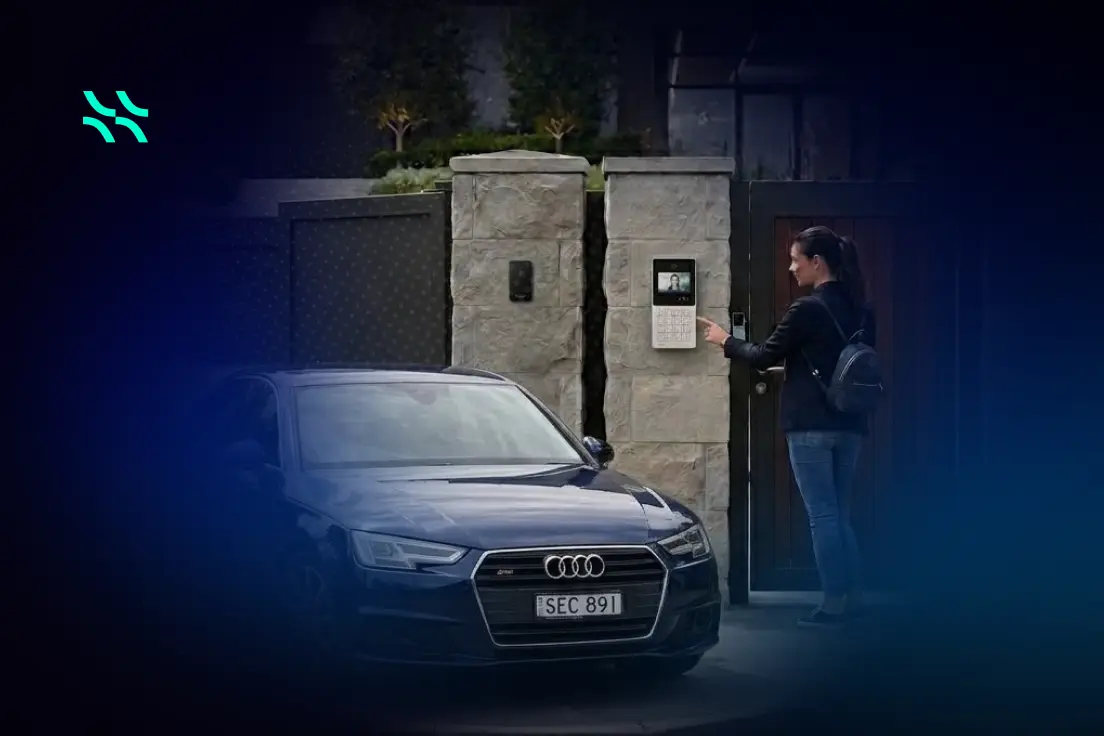
A typical pedestrian access scenario can combine two technologies.
Smart intercom. The intercom manages visitor communication and access authorization. Depending on the configuration, users can access the premises through:
- Face ID;
- temporary access links;
- access codes.
This provides a familiar access mechanism while giving the operator additional functionality to package into a managed service.
BLE controller. A BLE module enables contactless access using a smartphone.
Instead of relying exclusively on physical keys, residents, employees, or authorized users can use their smartphones as access credentials.
For telecom operators, this creates an opportunity to position access control as part of a broader digital customer experience rather than as a standalone hardware product.
Vehicle access in cloud access control solution: from smartphone authorization to gate opening
Vehicle access follows a similar service logic but involves different device types.
BLE controller. The BLE controller detects the authorized smartphone token when the user approaches the access point and verifies the access request.
This can provide a convenient hands-free or contactless experience for drivers.
Actuator. Once authorization is confirmed, the actuator triggers the physical barrier or gate to open.
Together, the BLE controller and actuator create a complete vehicle access scenario that can be managed as part of the operator’s access control service.
Two configuration models of cloud access control solution for different customer requirements
Basic pedestrian and vehicle scenarios are useful for straightforward deployments. However, telecom operators also need flexibility when serving larger or more complex sites.
Aipix provides two zone types for this purpose: Fixed Zone and Universal Zone.
Fixed Zone: structured configurations for standard deployments
A Fixed Zone provides a controlled way to combine access devices for standard scenarios.
It supports:
- intercoms;
- BLE controllers;
- actuator devices.
The configuration allows up to two devices of different types.
For example, an operator can configure:
1 intercom + 1 BLE controller
for a location requiring both conventional intercom access and smartphone-based access.
The limitation makes the Fixed Zone suitable for predictable deployments where the access architecture does not require a large number of devices.
From a commercial perspective, this can support clearly defined standard packages that are easy for sales teams to explain, provision, and price.
Universal Zone: flexibility for complex deployments
Larger facilities often require more than a predefined combination of devices.
A business center may have several access technologies operating together. A large residential development may have multiple entrances and vehicle access points. An industrial site may require several controllers and actuators across different areas.
The Universal Zone is designed for these more complex configurations.
Unlike the Fixed Zone, it has no predefined limit on the number or combination of supported devices.
Operators can combine:
- intercoms;
- BLE controllers;
- actuator devices;
- multiple devices of the same type;
- different device types within one access configuration.
This gives operators more freedom to create access architectures around the customer’s actual site rather than forcing complex deployments into predefined packages.
Why configuration flexibility matters for cloud access control solution monetization
The technical flexibility of Access Points directly affects the commercial model.
A telecom operator does not have to create one universal price for access control. Instead, the service can be structured around the customer’s configuration.
For example, pricing can take into account:
Number of Access Points → Number of devices → Number of locations → Required functionality → Additional services
This creates a more scalable relationship between the customer’s technical requirements and the operator’s recurring revenue.
A small customer can start with a basic configuration, while a larger customer can generate significantly higher service revenue through additional access points, devices, locations, and premium functionality.
Building cloud access control solution packages
Access Points can become the foundation for several commercial packages.
1. Basic access control subscription
The operator can offer a standard monthly subscription that provides access control through a mobile application.
This can be positioned as an entry-level service for residential customers and small facilities.
The package can include a predefined number of Access Points or devices, creating a clear baseline for the service.
2. Additional Access Points
Customers with more entrances can pay for additional Access Points.
For example, a residential complex could start with one pedestrian entrance and later add:
- another building entrance;
- a parking entrance;
- a vehicle gate;
- an additional site.
Each additional Access Point can become an incremental source of recurring revenue.
3. Device-based expansion
The operator can also monetize the expansion of the underlying infrastructure.
As customers add new access functionality, the service can grow through additional:
- intercoms;
- BLE controllers;
- actuator devices.
This creates a natural expansion path without requiring the customer to switch to another platform.
4. Premium plans for larger properties
Larger customers can be offered premium service tiers based on the scale and complexity of their deployment.
A premium package could be designed for:
- multi-entrance residential complexes;
- business centers;
- industrial facilities;
- parking facilities;
- multi-site organizations.
The commercial difference is not simply “more devices.” A premium plan can package higher deployment scale and broader access functionality into a predictable recurring subscription.
Bundling access control with existing telecom services
One of the strongest opportunities for access points monetization is bundling.
Telecom operators already provide connectivity and increasingly offer additional digital services to businesses, property managers, and residential customers.
Access control can therefore become part of a broader smart-property portfolio.
For example:
Internet + Access Control
A connectivity customer can add managed access control as an additional monthly service.
Internet + Video Surveillance + Access Control
A property can combine connectivity, cloud video surveillance, and access management under one operator relationship.
Internet + Video Surveillance + Video Analytics + Access Control
For business and industrial customers, access control can become part of a broader security package that includes video monitoring and analytics.
The advantage is that the operator can increase revenue per customer without having to acquire an entirely new customer for every additional service.
Different customer segments, one service model
The same access control platform can support different customer segments while allowing the operator to adapt the commercial offer.
| Customer type | Typical requirements | Potential service model |
|---|---|---|
| Small residential building | Pedestrian entrance | Basic subscription |
| Residential complex | Multiple entrances + parking | Access Points + device expansion |
| Parking facility | Vehicle access | Vehicle access subscription |
| Business center | Multiple pedestrian and vehicle entrances | Premium multi-Access Point package |
| Industrial facility | Multiple access zones | Universal Zone + customized package |
| Multi-site business | Access across several locations | Multi-location subscription |
The underlying service remains the same, while the configuration and pricing can scale with the customer’s requirements.
Why logical access entities simplify operations for cloud access control solution
The commercial benefits depend on operational scalability.
If the operator has to manually design a new service architecture for every customer, access control becomes difficult to scale.
Logical Access Points provide a common abstraction layer.
The operator can manage access scenarios through standardized entities while still supporting different physical configurations.
This can simplify:
- service provisioning;
- customer configuration;
- device management;
- service expansion;
- package design;
- recurring billing logic;
- support for different customer segments.
The result is a model where technical complexity can remain behind the platform while the customer sees a straightforward managed service.
Conclusion
Access control can become a valuable addition to a telecom operator’s VAS portfolio, but its commercial potential depends on how easily the service can adapt to different customer requirements.
With Aipix Access Points, operators can organize pedestrian, vehicle, and more complex access scenarios through manageable logical entities. Fixed and Universal Zones provide different levels of configuration flexibility, allowing the same platform to serve everything from small residential buildings to large business and industrial facilities.
More importantly, this flexibility supports a scalable access points monetization strategy.
Operators can start with a basic access subscription, add Access Points and devices as customer requirements grow, introduce premium configurations, and bundle access control with Internet, Video Surveillance, and Video Analytics.
In this model, access control is no longer simply another device category. It becomes a recurring telecom service with multiple paths for customer expansion and revenue growth.
Contact the Aipix team to discuss cloud access cotnrol service deployment and monetization options




 EN
EN  ES
ES  FR
FR  PL
PL  PT
PT