

Unified Security for Smart Compounds: How Telecom Providers Can Deliver It
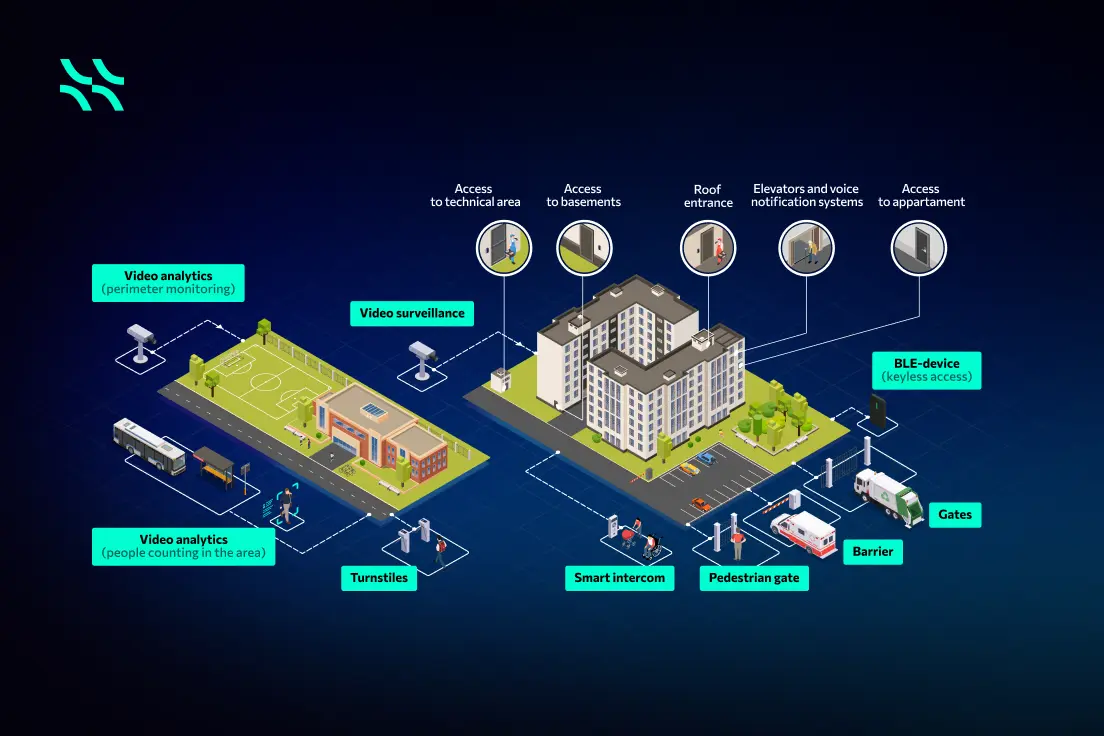
For telecom operators, residential complexes represent more than a concentration of Internet subscribers; it’s an opportunity to run unified security solution for smart compound. They are environments where a wide range of digital services are already being deployed: cloud video surveillance, smart intercoms, access control, video analytics, monitoring, and other connected solutions.
The challenge is that these services are often delivered separately. The telecom operator provides connectivity, a security company operates video surveillance, another contractor manages access control, and the management company has to coordinate the different systems.
This fragmented model creates a gap between the infrastructure the operator provides and the services that run on it.
A centralized platform changes this relationship. Instead of remaining only the connectivity provider, the telecom operator can become a single technology partner for the residential complex, combining smart services into one managed ecosystem.
Based on Aipix, this ecosystem can bring together cloud video surveillance and AI video analytics, unified access control, centralized monitoring, and a scalable White Label service model.
Cloud video surveillance and AI video analytics: turning cameras into a part of security solution for smart compound
Video surveillance is one of the most established smart services in modern residential complexes. Cameras are installed around entrances, courtyards, parking areas, playgrounds, building perimeters, and other common spaces.
However, simply installing cameras does not create a complete digital service. The value comes from how the video is collected, stored, accessed, analyzed, and used for operational decisions.
With a cloud-based video surveillance model, cameras across a residential complex can be connected to a centralized platform rather than being managed as isolated local systems. The video infrastructure becomes part of a service operated by the telecom provider.
The operator can organize cameras by residential complex, building, location, and specific area, while controlling access for different categories of users.
For residents, this can mean convenient access to relevant cameras through the service application. Management companies can receive access to video from common areas. Security personnel can work with a broader set of cameras required for operational monitoring.
This centralized model also simplifies the expansion of video surveillance. When a new building, parking area, entrance, or other facility is added to the residential complex, its cameras can become part of the same service environment instead of requiring a completely separate video system.
Video archive as part of the service
Cloud video surveillance can also include centralized video storage. Instead of relying exclusively on local recording equipment at the residential complex, the operator can offer archive storage as a managed service.
This creates another commercial opportunity because archive retention can become part of the service package. Different customers may have different requirements: some may need access only to recent footage, while others may require longer retention periods.
The operator can therefore create different service levels based on archive duration and other video-service parameters. This turns storage from a technical requirement into a monetizable component of the video surveillance service.
AI video analytics adds an intelligence layer of security solution for smart compound
AI video analytics extends the value of the camera infrastructure by allowing video streams to be analyzed automatically. Instead of requiring personnel to continuously watch dozens of camera feeds, analytics can detect predefined events and generate alerts or structured data.
Depending on the use case, analytics can support:
- people counting;
- license plate recognition;
- facial recognition;
- line crossing detection;
- intrusion detection;
- occupancy monitoring;
- other event-based scenarios.
Consider a parking area in a residential complex.
A conventional camera records what happens there. With video analytics, the system can identify vehicles, count traffic, detect activity in defined areas, or trigger an event when a configured condition occurs.
The difference is important: video surveillance provides visibility, while analytics turns that visibility into actionable information.
This can reduce the amount of manual monitoring required and help management companies and security teams respond to relevant events faster.
Analytics also creates an upsell opportunity
For the telecom operator, video analytics does not have to be part of every basic surveillance subscription. It can be positioned as an additional service layer.
A customer can start with cloud video surveillance and later add specific analytics scenarios according to their needs.
For example, a residential complex may initially require only video monitoring. Later, the management company may request license plate recognition for parking, people counting for specific areas, or line-crossing detection for restricted zones. The operator can provide these capabilities without replacing the entire video infrastructure.
This creates a natural path from a basic video service to higher-value smart security services.
Unified access control: connecting intercoms, BLE, gates, and barriers when running security solution for smart compound
Video surveillance provides visibility into what is happening around a residential complex. Access control determines who can enter its buildings and controlled areas.
Modern residential complexes can have a large number of access points, including building entrances, pedestrian gates, parking entrances, vehicle barriers, turnstiles, and service areas.
These points are often equipped with different technologies and supplied by different vendors. As a result, access control can become another fragmented part of the residential infrastructure.
A centralized approach allows these devices to be organized within one access-control environment.
Aipix uses the concept of Access Points to organize different access devices as part of a common system. An Access Point can represent a physical location where access is controlled, while the underlying infrastructure can include smart intercoms, BLE controllers, gates, barriers, and turnstiles.
This creates a more logical structure for the residential complex.
Instead of managing a collection of unrelated devices, the operator can manage access according to the actual locations and functions within the property.
For example, the same residential complex can include:
- a smart intercom at the main entrance;
- a BLE controller at a pedestrian gate;
- a barrier at the parking entrance;
- a turnstile in a restricted facility;
- additional controlled doors inside buildings.
All of these can be treated as components of the same access-control environment.
Contactless BLE access
BLE access provides residents with a contactless way to interact with supported access points using a smartphone. This can be particularly useful in residential environments where residents regularly move through multiple controlled areas.
Instead of relying on separate physical access credentials for different locations, supported BLE access can provide a more consistent digital access experience.
For the operator, BLE access is also another service that can be incorporated into the wider smart residential portfolio rather than being deployed as an isolated access-control product.
Access control and video surveillance work together in security solution for smart compound
The relationship between access control and video surveillance is particularly important. An access point is a physical location, and that location can also be covered by one or more cameras. This means that access events and video can provide complementary information.
For example, when an incident occurs at a building entrance, security personnel may need both the access information and the corresponding video footage to understand the situation. When these services operate within the same ecosystem, the operator can create a more complete operational picture of what is happening at the residential complex.
Access control therefore becomes more than a mechanism for opening doors or gates. Combined with video surveillance and analytics, it becomes part of the broader security infrastructure.
Monitoring center as a part of security solution for smart compound: centralized control of the residential infrastructure
When a residential complex contains dozens or hundreds of cameras and access points, simply collecting information is not enough. Someone needs to monitor events, evaluate incidents, and coordinate responses.
This is the role of a centralized monitoring center. Instead of requiring each residential complex to operate its own isolated monitoring environment, a telecom operator can centralize operational control across multiple facilities.
The monitoring center can bring together information generated by the connected infrastructure, including video streams, analytics events, and relevant access-control events.
The operational logic becomes much more efficient: the system detects an event → the monitoring team receives information → the relevant video or access data is reviewed → the situation is assessed → appropriate action is taken.
This is particularly important for incident management.
Consider a line-crossing event detected near a restricted area. Instead of relying on a security employee to notice the event manually, the analytics system can generate an alert. The monitoring operator can then access the relevant camera feed and assess what is happening. The same principle can apply to other predefined security events.
Scalability and white label: turning the platform into the operator’s own service portfolio
A smart residential ecosystem cannot remain limited to one residential complex or a fixed set of services. The operator needs to be able to add new customers, new buildings, new devices, and new services without rebuilding the entire infrastructure.
This is where scalability becomes commercially important. Aipix can provide a centralized platform on which the operator can organize services across multiple residential complexes.
A new property can be added to the existing environment, with its own cameras, access points, users, permissions, analytics scenarios, and service configuration.
The operator can therefore create a repeatable service model. This is particularly relevant for telecom companies that already serve large numbers of residential properties. Instead of treating every smart-complex project as a unique integration project, the operator can develop a standardized portfolio that can be deployed across different sites.
Expanding the service portfolio
Scalability also applies to the services themselves. A customer may start with cloud video surveillance and later require:
- longer video archive retention;
- additional analytics;
- smart access;
- BLE access;
- additional access points;
- centralized monitoring;
- new cameras or facilities.
Because these services are organized within the same platform, the operator can expand the customer’s service portfolio without creating a completely separate technology environment for each new capability. This supports a long-term customer relationship.
The operator can start with one service and gradually increase the number of services provided to the same residential complex.
White Label: the operator owns the customer experience
White Label capabilities are particularly important from a commercial perspective. The underlying technology may be provided by Aipix, but the service can be presented to the market as the telecom operator’s own offering.
This allows the operator to maintain its existing brand relationship with residents, developers, and management companies. The customer does not need to establish separate relationships with multiple technology vendors.
Instead, the telecom operator becomes the visible service provider for the smart residential ecosystem. This also allows the operator to define its own:
- service packages;
- pricing;
- subscription models;
- customer communication;
- support model;
- additional-service strategy.
The technology platform becomes the infrastructure behind the operator’s service portfolio.
What running security solution for smart compound means for the telecom business growth
For developers and management companies, the main benefit is reduced fragmentation. Instead of coordinating separate suppliers for connectivity, video surveillance, access control, analytics, and monitoring, they can work with one technology partner responsible for a larger part of the digital infrastructure.
For residents, the benefit is a more consistent service experience. Instead of navigating multiple unrelated systems, they can access relevant smart-complex services through one ecosystem, with a unified support and payment relationship.
For telecom operators, the impact is much broader.
The operator can move from selling one core service — Internet access — to managing a portfolio of recurring digital services:
Internet + Video Surveillance + Archive + Video Analytics + Smart Access
Each additional service creates another monetization opportunity while increasing the value of the overall relationship. The operator can also use the same platform across multiple residential complexes, expanding the number of customers and services without creating a separate operating model for every property.
This is the real opportunity behind a centralized smart residential platform.The goal is not simply to add video surveillance, access control, or analytics to a telecom portfolio. It is to make the operator the single digital infrastructure and smart-services partner for the residential complex.
From connectivity to the residential digital ecosystem
Residential complexes are already becoming ecosystems of connected devices and digital services. The question is whether telecom operators will remain the companies that simply provide the network underneath them — or become the companies that organize, operate, and monetize the services running across that network.
A centralized Aipix-based environment gives operators the foundation to combine cloud video surveillance, AI video analytics, smart access, and monitoring into one service portfolio.
For the operator, it means a larger role in the customer relationship, new B2B and B2C revenue streams, and more opportunities to increase ARPU through additional services.
The network connects the residential complex. A unified smart-services platform can turn that connectivity into a broader business ecosystem.
With Aipix, telecom operators can build a unified portfolio of smart residential services under their own brand. Contact us to explore how video surveillance, analytics, smart access can become new sources of recurring revenue specifically for your business.
Get your "VSaaS Market 2025-2026 Report"
Leave your e-mail and we’ll send you the file





 EN
EN  ES
ES  FR
FR  PL
PL  PT
PT