

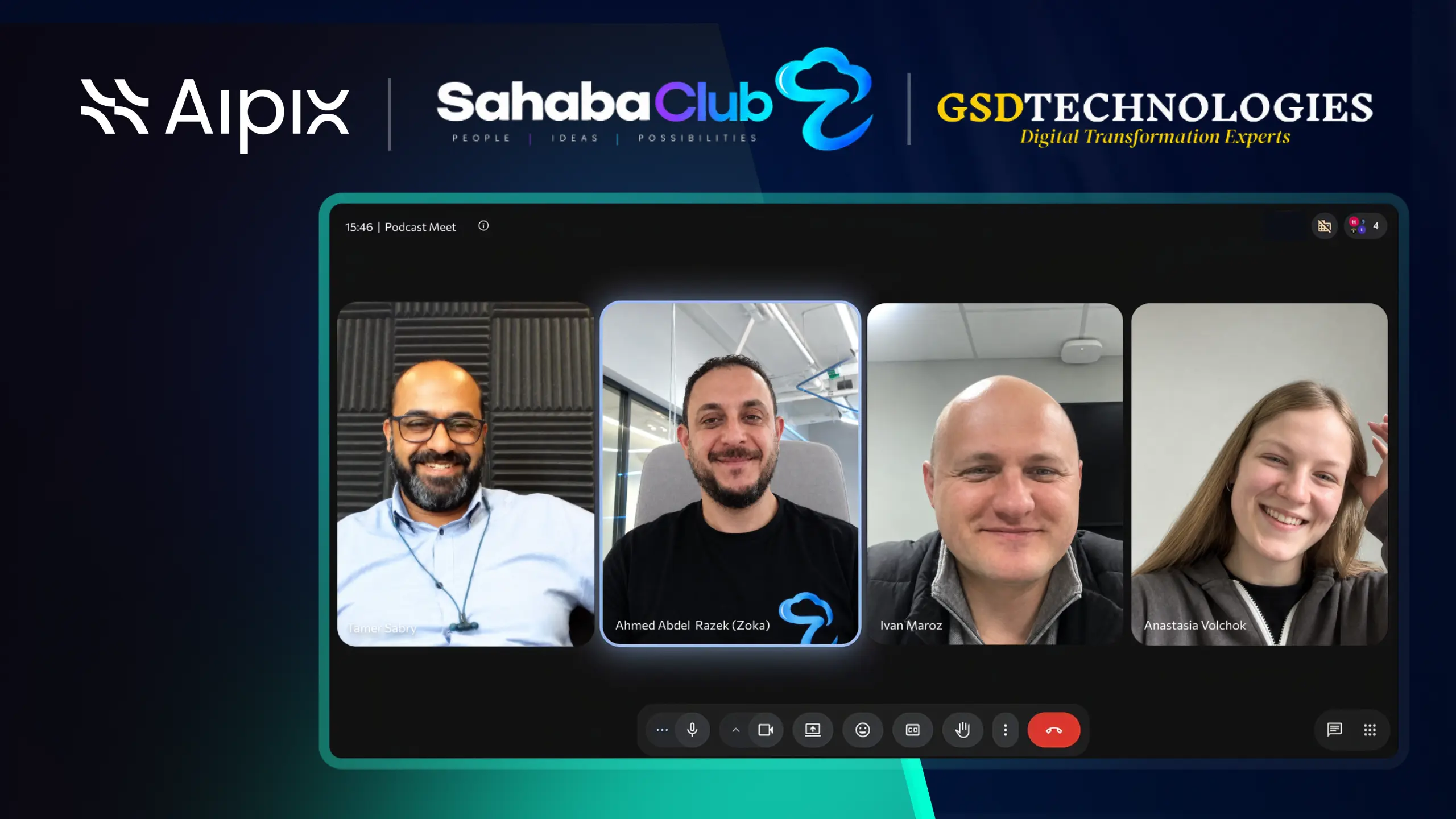
Cloud Video Surveillance and AI in Egypt and the GCC: insights from Aipix, GSD Technologies, and Sahaba Club
How do cloud video surveillance and AI move from promising technologies to working business solutions? What are the realistic prospectives of development of cloud video surveillance and AI in Egypt? For companies managing cameras across multiple locations, the answer involves more than new software. It requires connecting existing systems, simplifying operations, and turning video data into information people can use.
In this Aipix Podcast interview, Aipix brings together three experts working at the intersection of cloud security, AI, and business development:
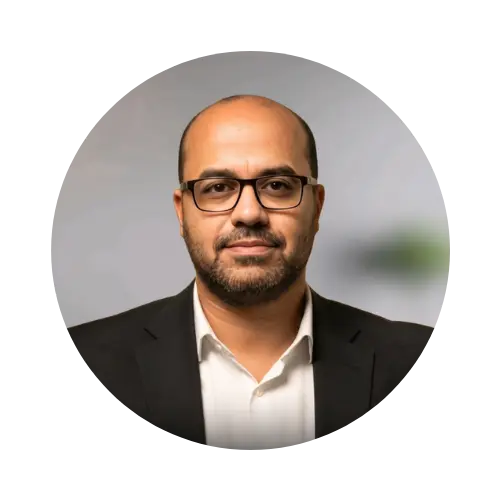
Domador Sabry, Founder and Commercial Director of GSD Technologies. Tecnologías GSD is Aipix’s partner and official representative in Egypt, providing video management and AI video analytics solutions for commercial, real estate, and industrial customers. Tamer brings hands-on experience delivering projects in Egypt and working across African markets.

Ahmed Abdel Razek “Zoka,” Founder and CEO of Sahaba Club. Sahaba Club is a Dubai-based technology community focused on AI, cybersecurity, and cloud technologies. Through practical learning programs, hackathons, webinars, and market-entry support, it connects technology professionals, business leaders, and international vendors.

Iván Maroz, Business Development Director at Aipix. Aipix provides a cloud platform for video surveillance, gestión de acceso, y análisis de vídeo. Ivan works on developing cloud security projects across Africa and the Middle East and North Africa (MENA), bringing the perspective of a technology provider working with local partners and telecom operators.
Together, they discuss what deployment looks like in practice, where demand is developing in Egypt and the Gulf Cooperation Council (GCC) markets, and how video analytics and generative AI could support better business decisions.
Watch the video:
Cloud video surveillance: from market demand to deployment
Moving beyond passive CCTV
Anastasiya: Tamer, what kinds of customers does GSD Technologies work with, and what projects do you primarily deliver?
Tamer: GSD Technologies provides technology solutions, particularly AI video analytics. Our focus is on transforming passive CCTV systems into an active source of data: helping customers use their cameras for analytics, visualization, and centralized management.
We have been in the market for around five years, and this is our second year working with Aipix. Most of our experience is in commercial projects and real estate, with some work in the industrial sector. Together with Aipix, we have started projects in retail and gold manufacturing, and we are working on a project for a major residential compound in Egypt.
Anastasiya: From your experience with customers, what advantages do cloud solutions offer compared with traditional video management systems?
Tamer: In Egypt, cloud is becoming essential. Infrastructure costs are high, while improvements in fiber connectivity and internet services are creating more opportunities to use cloud solutions.
For customers, the value is being able to manage cameras and access points without maintaining local servers at every site. The larger the installation, the more important centralized management becomes.
For example, we are working on a case involving approximately 3,000 cameras and 200–300 network video recorders. Managing the cameras, recordings, and archive across that many devices is difficult without a centralized video management system. That is where a solution like Aipix can make a real difference.
Retail and gold manufacturing: connecting distributed sites
Anastasiya: Could you share more about the projects you are working on and the challenges involved?
Tamer: Let’s start with retail. We have two live retail projects, while the real estate project is still in the implementation phase.
The main challenge in retail is integration. Customers have multiple sites, different cameras and recording systems, their own dashboards, and management information systems. We need to bring CCTV, analytics, and business systems together through one centralized point.
With Aipix and our dashboards in the cloud, we can connect the existing cameras using internet connectivity and VPN connections, with very little additional hardware at the sites.
The first phase of one project covers around 30 retail shops across different cities and governorates in Egypt. The planned functionality includes face recognition, people counting, centralized video management, restricted-zone monitoring, and intrusion detection.
Another project involves a gold manufacturer with high security requirements. We are working on an installation of approximately 3,000 cameras. The CEO is based in the United States, the team is in Egypt, and branches are spread across Saudi Arabia, Bahrain, Qatar, and the UAE.
They need a centralized way to access cameras across their operations while controlling infrastructure and archive costs. The licensing model we discussed for this project was also important: the customer wanted clarity about the initial payment and any additional charges.
Analytics is another part of the value. Customers often associate it with additional GPUs, servers, and hardware. Our approach with Aipix gives them a simpler way to add analytics to their video system.
Hardware and procurement challenges across regional markets
Anastasiya: Do you see similar challenges elsewhere in the region?
Tamer: Yes. I have worked in several African markets, including Cameroon, Kenya, Ghana, Côte d’Ivoire, and Egypt, and many of the same issues come up: connectivity, hardware costs, and long procurement timelines.
In some cases, importing a GPU can take three to six months. A project can be delayed because it is waiting for one piece of hardware. Delivering services through the cloud can reduce that dependence on equipment being installed locally.
We also see opportunities in the GCC. The gold manufacturing project is an example of a business that needs to manage operations across Egypt and several Gulf countries through a single system.
Growth opportunities in Egypt and the GCC
Residential real estate and hospitality
Anastasiya: Beyond retail and commercial projects, which sectors do you see as promising in Egypt?
Tamer: Our initial commercial plan focused on small and medium-sized customers, including retail businesses. The next areas we want to develop are residential real estate and hospitality.
There is significant activity in tourism and real estate investment in Egypt, which creates opportunities in residential compounds, complexes, and hospitality properties.
We may expand further into manufacturing, but that will require additional analytics models and capabilities. It is something we could explore with Aipix. For now, our focus is on commercial and administrative buildings, followed by residential projects.
Telecom operators and the subscription service model
Iván: Telecom operators could also be important customers or partners because they already have data centers and fiber infrastructure. Tamer, how do you see their interest in services for residential customers?
Tamer: There is an opportunity, but we need to build awareness of the business model. We are already in discussions with operators in Egypt.
They are familiar with providing routers, access points, and connectivity. Extending that approach to cameras, intercoms, and related services is the next step.
We are working from two directions: talking to telecom providers about the value of Aipix and talking to residential compounds about delivering these services through their connectivity providers. Operators already provide fiber infrastructure to compounds, so there is a basis for adding services for villas and apartments.
Iván: We also see interest in cloud video surveillance as a service in the GCC, particularly among Saudi operators.
The opportunity is to offer video surveillance through a monthly subscription alongside internet connectivity. Some operators still approach it mainly as an integration project: supplying equipment and connecting it. Moving to a service model requires a different understanding of how to package and deliver the offer.
Successful local projects will help. Once we have completed more deployments in Egypt, we will have practical examples to show operators how the model works.
Making technology accessible through experience
Anastasiya: Ahmed, could you introduce Sahaba Club and explain its main idea?
Ahmed: Sahaba Club is a virtual club focused on technology. Instead of playing sports, we explore AI, cybersecurity, and cloud technologies.
We started as a community in 2020 and are now based in Dubai. Our approach is practical and activity-based: people learn by participating, experimenting, and building something.
One of our educational programs uses a hackathon format. Over ten days, participants move from learning the basics of AI and development to building a solution and preparing the elements around it, including its identity and pitch.
We also run Weekly Wednesday Webinars with guests who share their experience. Tamer has delivered several coaching sessions on technology sales.
Another activity is Prompt Arena, where participants learn prompt engineering through a competitive game. We also organize hackathons and take part in technology events.
Beyond education, we help international vendors enter the market through digital marketing and business development. That includes working with a sales team on the ground and connecting vendors with people in our community, including IT managers and technology leaders.
Tamer: I have also been encouraging Ivan to join us as a coach and deliver a session on video analytics. There is an opportunity to combine technology, market experience, and education.
Iván: I have already registered with Sahaba Club, so that is something we can explore.
Building a reliable foundation for video analytics within cloud video surveillance and AI in Egypt
Secure storage and accessible video data
Anastasiya: From your different perspectives, what are the main opportunities and challenges for AI in video surveillance?
Ahmed: I see an important opportunity in the infrastructure behind video: storing recordings securely and making them accessible for analysis.
Previously, a business could record large amounts of video without anyone reviewing it. AI creates more ways to use those recordings and combine them with other data.
As AI capabilities develop, customers may want to use their own models or an AI service. In either case, they need a reliable foundation for storing and streaming video securely. That infrastructure will be an important part of the market.
Making analytics work in real operating conditions
Iván: Another challenge is the quality of the analytics itself. Developing and training AI models is not easy. A system may look impressive in a presentation, but it must also work in real operating conditions.
That requires experienced specialists, appropriate datasets, and substantial training. Our team developed Aipix’s CPU-based video analytics from scratch, and that work took time.
We are continuing to develop it. At the time of this discussion, we are working toward additional capabilities, including heatmaps running on CPU infrastructure. Industrial analytics is another area we may explore in the future.
Governance, security, and enterprise adoption
Ahmed: Governance and security are also important. The fact that a technology is available does not automatically mean an enterprise can adopt it.
Large businesses, banks, and government organizations need providers they can trust to deliver a complete solution. They need experience with the use case, a clear approach to security, and the ability to manage the implementation end to end.
Iván: Banking could be another area for future discussion in Egypt. A bank with separate surveillance systems at each branch may benefit from centralized management. It is a potential use case we could explore with GSD Technologies.
From analytics results to business decisions
Combining technology, AI expertise, and market experience
Anastasiya: How could Aipix, GSD Technologies, and Sahaba Club combine their expertise to create new use cases?
Tamer: This is an idea we would need to develop together. Aipix provides video management and analytics. Sahaba Club has expertise and resources that could help build dashboards, integrations, and AI capabilities on top of that. GSD brings customer relationships and sales experience in Egypt and the GCC.
The next step is to move beyond individual detections. Counting how many people enter and leave is useful, but customers also want to understand what the information means for their business.
For a bank, for example, we would need to offer more than face detection. The opportunity is to provide insights into activity across branches and help the customer understand patterns that matter to operations and security.
Open APIs and integrated business dashboards
Iván: Aipix has an open API that supports integrations with third-party software. We have already had cases in Africa where the platform was integrated with Microsoft Power BI for data visualization and additional scenarios based on video and analytics data.
That experience gives us a foundation for exploring further integrations together for larger customers.
Tamer: Our first retail project in Egypt also used the Aipix API. We combined video analytics with other information to provide commercial insights into store performance.
The work brought together analytics such as people counting, age and gender estimates, and face recognition with financial and business information. The purpose was to help the customer understand purchasing patterns and consider what to do next.
Generative AI as a layer for interpretation and reporting
Ahmed: Generative AI can add another layer to that process. Computer vision produces results from images and video. We can then use those outputs as input for further interpretation and reporting.
For example, information about customer behavior inside a store could help a retailer consider how to reorganize the space. Rather than stopping at a count or a classification, we can explore how the data helps answer a business question.
Predictive insights are another possibility, although they require appropriate models and training. The broader opportunity is to use a centralized pool of data to understand problems and support decisions.
Iván: A useful next step would be to connect our technical teams and examine possible integrations and developments together.
Ahmed: We would be happy to explore that.
Anastasiya: Thank you all for sharing your experience and ideas. The conversation shows how much depends on bringing the right elements together: video infrastructure, reliable analytics, local market knowledge, and the skills to turn technology into a useful service.
We at Aipix extend our sincere thanks to everyone who took part in this discussion for sharing their experience and insights, and for their trust and cooperation.
The discussion points to a clear opportunity: cloud video surveillance and AI in Egypt can give businesses a centralized foundation for managing security, while AI helps turn video data into insights for operations and planning. Projects in Egypt already show how this approach can connect distributed sites, integrate existing systems, and reduce the need for additional local infrastructure.
Taking that further requires a combination of reliable technology, local market experience, and AI expertise. Aipix, GSD Technologies, and Sahaba Club see potential in bringing these strengths together, exploring integrations, developing new use cases based on the experience of cloud video surveillance and AI in Egypt, and helping businesses and telecom operators turn technical capabilities into practical services.
Ready to explore cloud video surveillance and AI for your business in Egypt or the GCC?
Talk to the Aipix team about your project, integration needs, and opportunities to launch new services. Let’s discuss your project




 ES
ES  EN
EN  FR
FR  PL
PL  PT
PT