
Black Friday and the holiday shopping season put retail operations under pressure. Higher customer traffic, promotional campaigns, busy store areas, and increased security demands make it more difficult for retailers to monitor activity and evaluate performance across multiple locations.
For telecom operators and internet service providers (ISPs), this seasonal demand creates an opportunity to go beyond connectivity. By offering cloud video surveillance and analyse vidéo for retail, providers can help business customers improve security, understand shopper behavior, and make more informed operational decisions — while generating recurring B2B revenue.
But how can retailers turn video surveillance into a source of business intelligence? And how can telecom operators deliver these capabilities as scalable subscription-based services?
Operators can combine centralized video surveillance, AI-powered video analytics, and Intégrations API to build a retail-focused service offering that delivers value throughout the year.
Why Is Video Analytics Important for Retail in 2026?
Retailers face two interconnected challenges: managing increasingly complex store operations and reducing losses without compromising the customer experience.
Traditional video surveillance helps retailers monitor premises and review recorded footage. However, manually watching camera feeds or searching through hours of recordings is not an efficient way to identify broader patterns across multiple stores.
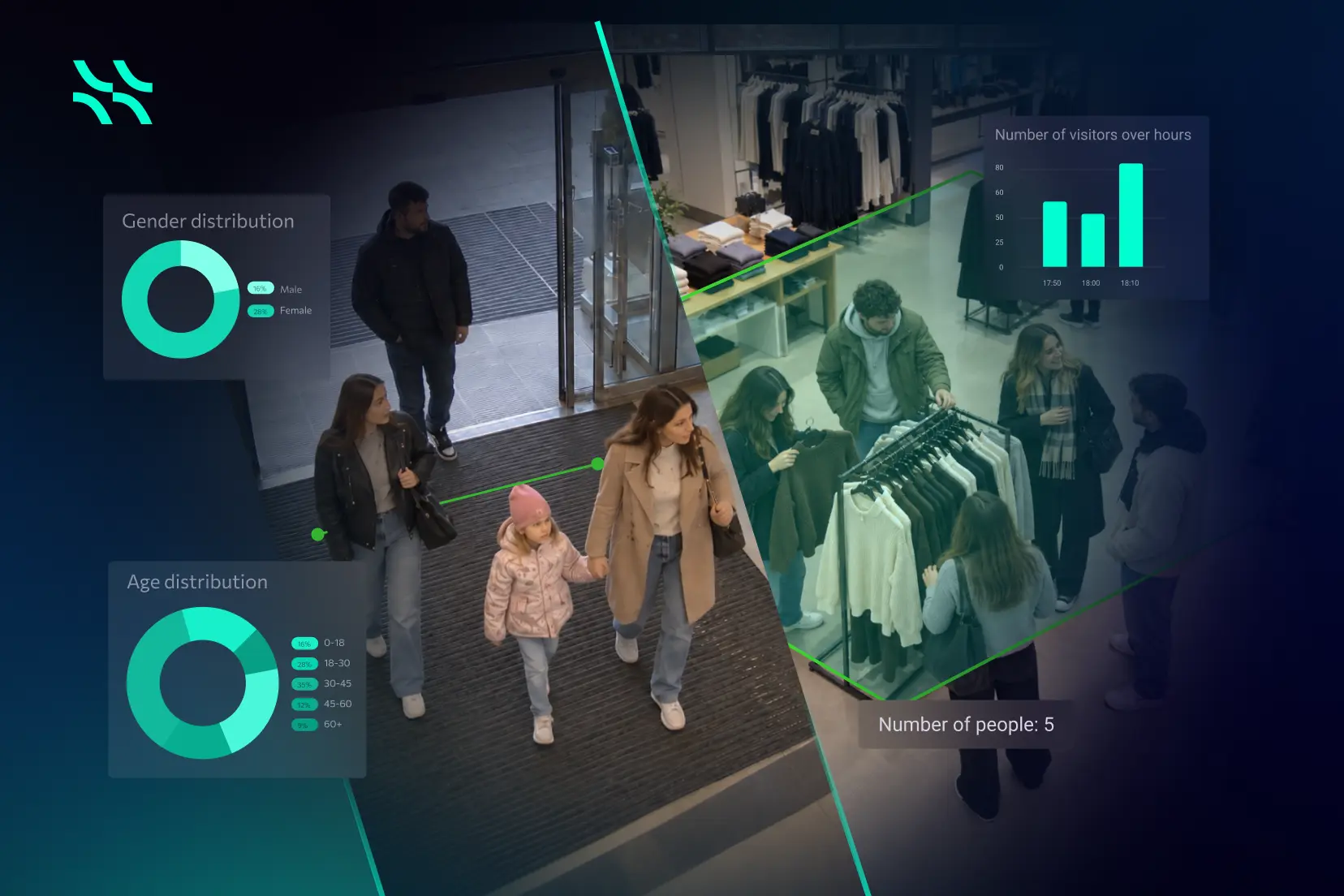
Video analytics for retail transforms camera streams into structured data about visitor traffic, demographics, and activity across defined store areas. When this information is combined with sales and transaction data, retailers can build a more complete picture of store performance.
During Black Friday, these capabilities can help retailers understand how traffic changes, where people concentrate, and which operational areas may require additional attention.
What Can Video Analytics for Retail Measure?
A retail-focused video analytics solution can help businesses understand not only how many people enter a store, but also how visitor activity varies across locations, time periods, and shopping areas.
1. How Can People Counting Help Retailers Measure Foot Traffic?
People counting measures the number of visitors entering or passing through defined areas, depending on the configured scenario.
Retailers can use these insights to:
- Compare visitor traffic between stores.
- Measure changes in foot traffic before, during, and after promotional campaigns.
- Identify days and hours with higher visitor volumes.
- Evaluate whether a campaign coincides with an increase in store visits.
2026 example: A fashion retailer in Northwestern Europe achieved at least 97.28% people-counting accuracy across all 10 stores in an independent verification covering 4,194 visitors, 67 hours, 22 counting lines, and 11 cameras. Reliable counts provide a stronger basis for comparing store performance and calculating conversion rates.
For example, a retailer can compare visitor counts during Black Friday with traffic on a typical shopping day. If traffic increases by 20%, the retailer can then compare this change with transaction volumes to understand whether sales are growing at a similar rate.
However, visitor numbers alone do not prove that a promotion increased sales. To evaluate commercial results, retailers should compare foot traffic with transaction data and other relevant business metrics.
2. How Does Peak-Hour Analysis Improve Retail Operations?
Peak-hour analysis helps retailers identify when stores experience the highest levels of visitor activity.
Retailers can use people-counting and peak-hour analytics to:
- Schedule employees according to observed customer traffic.
- Allocate staff to checkout areas and customer service points.
- Prepare for predictable rush periods.
- Compare peak hours across different store locations.
During Black Friday, similar analysis can help retailers align staffing and customer service with observed demand rather than relying on assumptions.
3. How Can Occupancy Monitoring Help Manage Busy Store Areas?
Occupancy monitoring measures the number of people in a defined area and can trigger alerts when configured thresholds are reached.
Depending on the deployment and camera coverage, retailers can use it to monitor entrances, promotional zones, checkout areas, or other locations where crowding needs attention.
Potential applications include:
- Detecting when a designated area becomes too crowded.
- Supporting staff deployment in high-traffic zones.
- Monitoring visitor distribution across store areas.
- Helping teams respond when occupancy exceeds predefined limits.
For example, it can lead to a 47% reduction in average checkout queue length, from seven customers to four, at one retail site using AI-powered video monitoring and alerts. Also up to a 10% reduction in unnecessary checkout openings during off-peak hours. These are results from a specific deployment, not universal benchmarks.
For retailers, the business insight is that queue monitoring can help identify when checkout capacity needs adjustment. During major promotional events, this can support faster responses to congestion and more efficient use of staff.
4. How Can Visitor Demographics Support Retail Planning?
Where supported by the selected analytics scenario and applicable privacy requirements, demographic analysis can estimate visitor age groups and gender at an aggregate level.
Retailers can use these estimates to explore questions such as:
- Does the composition of store visitors change during a promotional campaign?
- Do different locations attract different audience groups?
- Are certain shopping periods associated with different visitor profiles?
Retail analytics example: video analytics revealed that more than half of shoppers were men or millennials, while baby boomers represented only a small proportion. This differed from the retailer’s marketing agency’s previous targeting assumptions and helped inform its online and in-store advertising strategy.
This example demonstrates how analytics can challenge assumptions about a store’s audience and help retailers reassess merchandising and marketing decisions. The figures come from a specific retailer and should not be treated as representative of the wider market.
Demographic results should be interpreted as estimates rather than verified individual characteristics, and used in accordance with local data protection and privacy requirements.
5. How Can Video Analytics Support Retail Security and Loss Prevention?
Video analytics can also support security teams by helping identify configured events, flag relevant activity, and locate footage for investigation.
The specific capabilities depend on the analytics solution and deployment. Examples may include detecting movement across defined lines, monitoring selected areas, or generating alerts when supported scenarios are triggered.
The 2026 Retail Loss Prevention Benchmark Report from Interface Systems illustrates the potential of combining video verification with a defined incident-response process. Across its monitored retail operations, 95% of alarm events were resolved as false alarms through video verification, avoiding unnecessary emergency responses. The report also found that 62.4% of high-priority security events were resolved without police dispatch when interactive remote video monitoring was deployed.
These are results from Interface Systems’ specific monitoring service and operating environment, not universal performance guarantees for video analytics platforms.
For retailers, the broader takeaway is that video can be used for more than recording events. When supported by appropriate analytics, monitoring workflows, and response procedures, it can help teams identify relevant activity and investigate incidents more efficiently.
For telecom operators, these capabilities provide an additional use case for cloud video surveillance services.
How Can Retailers Connect Video Analytics with Sales Data?
Video analytics becomes more valuable when its results can be compared with information from other business systems.
Through Aipix API integrations, video analytics data can be shared with external platforms, allowing retailers to combine visitor activity with sales, transaction, and operational data.
This creates opportunities to investigate questions that camera footage alone cannot answer.
For example, retailers can:
- Estimate store conversion rates: Compare visitor counts with transaction volumes over matching periods, using consistent measurement definitions.
- Evaluate promotional campaigns: Compare changes in foot traffic with changes in sales and transaction numbers.
- Benchmark store locations: Identify differences in visitor activity and commercial performance across branches.
- Analyze peak-period performance: Examine whether higher visitor volumes coincide with increased transactions or average transaction values.
- Identify areas for investigation: Flag locations with high visitor traffic but comparatively low transaction volumes for further analysis.
Consider a retailer operating 20 stores. During Black Friday, the business records increased foot traffic in several branches, but transaction volumes do not rise at the same rate.
By combining video analytics with point-of-sale data, the retailer can identify which locations and time periods require closer investigation. Possible explanations might include insufficient staffing, product availability, checkout delays, or differences in promotional effectiveness.
The integrated data does not automatically identify the cause. Instead, it gives retail teams a more focused starting point for operational analysis.
The key distinction is simple: video analytics measures visitor activity, while integration with business systems helps retailers assess how that activity relates to commercial results.
What Can Telecom Operators and ISPs Offer Retail Customers?
For telecom operators and ISPs, retail video analytics is more than an additional technical feature. It can become part of a managed, subscription-based B2B service portfolio.
The Aipix platform enables providers to build offerings around cloud video surveillance, video analytics, and integration with external business systems.
1. Centralize Security Management Across Retail Locations
Retail chains often operate multiple stores with cameras deployed across different locations. Managing this infrastructure through separate systems can complicate monitoring, maintenance, and incident investigation.
With a centralized cloud video surveillance service, operators can provide retailers with a unified environment for managing supported cameras and accessing video from distributed locations.
Value for retailers:
- Centralized visibility across stores.
- Simplified access to recorded footage.
- More consistent monitoring procedures.
- Easier expansion as new locations are added.
Value for operators:
Cloud video surveillance can be offered as a recurring subscription that scales with the customer’s camera count, locations, storage requirements, and selected service features.
2. Transform Video Surveillance into an Analytics Service
Operators can extend their surveillance offering with analytics scenarios such as people counting, occupancy monitoring, demographic estimation, and area-based traffic analysis.
Retailers can select capabilities according to their operational requirements instead of purchasing an unrelated standalone analytics system for every location.
Value for retailers: More actionable information about visitor activity and store operations.
Value for operators: An opportunity to introduce analytics as an additional subscription or service tier, increasing the value of an existing customer relationship.
3. Connect Video Analytics with Retail Business Systems
Retailers may already use point-of-sale platforms, business intelligence tools, CRM systems, workforce management software, and reporting dashboards.
Aipix API integration can help providers connect video analytics data with these external systems, subject to the relevant API capabilities and integration requirements.
Value for retailers: A more comprehensive view of store activity alongside sales and operational metrics.
Value for operators: A service offering that can be adapted to customer workflows and extended through integrations rather than limited to video access alone.
4. Build a Scalable Service for Retail Networks
A retailer may begin with a few cameras and basic monitoring before adding analytics, storage, more locations, or business-system integrations.
A cloud-based service model allows operators to develop their offering in stages, according to the customer’s requirements and deployment capacity.
A practical expansion path can include:
- Launch cloud video surveillance for selected retail locations.
- Add relevant video analytics scenarios.
- Integrate analytics data with external business systems.
- Expand camera coverage and service capabilities as requirements evolve.
The result is a service portfolio that can develop alongside the retailer’s business.
Conclusion: Turn Retail Video Analytics into a Long-Term B2B Service
Black Friday highlights the importance of understanding what happens inside physical stores. Visitor counts, occupancy data, and insights into store traffic can help retailers prepare for peak demand and evaluate operational performance.
The latest 2026 research also demonstrates why these capabilities deserve attention: retailers expect video analytics adoption to grow, security incidents follow identifiable patterns, and inventory losses remain a substantial financial concern.
For telecom operators and ISPs, the opportunity extends beyond the holiday shopping season. By combining cloud video surveillance, AI-powered video analytics, and API integrations, providers can deliver services that support retailers’ ongoing security and business intelligence needs.
With Aipix, operators can turn video surveillance into a source of actionable retail insights — while building a scalable, subscription-based B2B service portfolio.
Ready to expand your service offering for retail customers?
Contact the our team to explore how cloud video surveillance and video analytics can help you develop value-added services for your B2B market.




 FR
 EN
 ES
 PL
 PT