

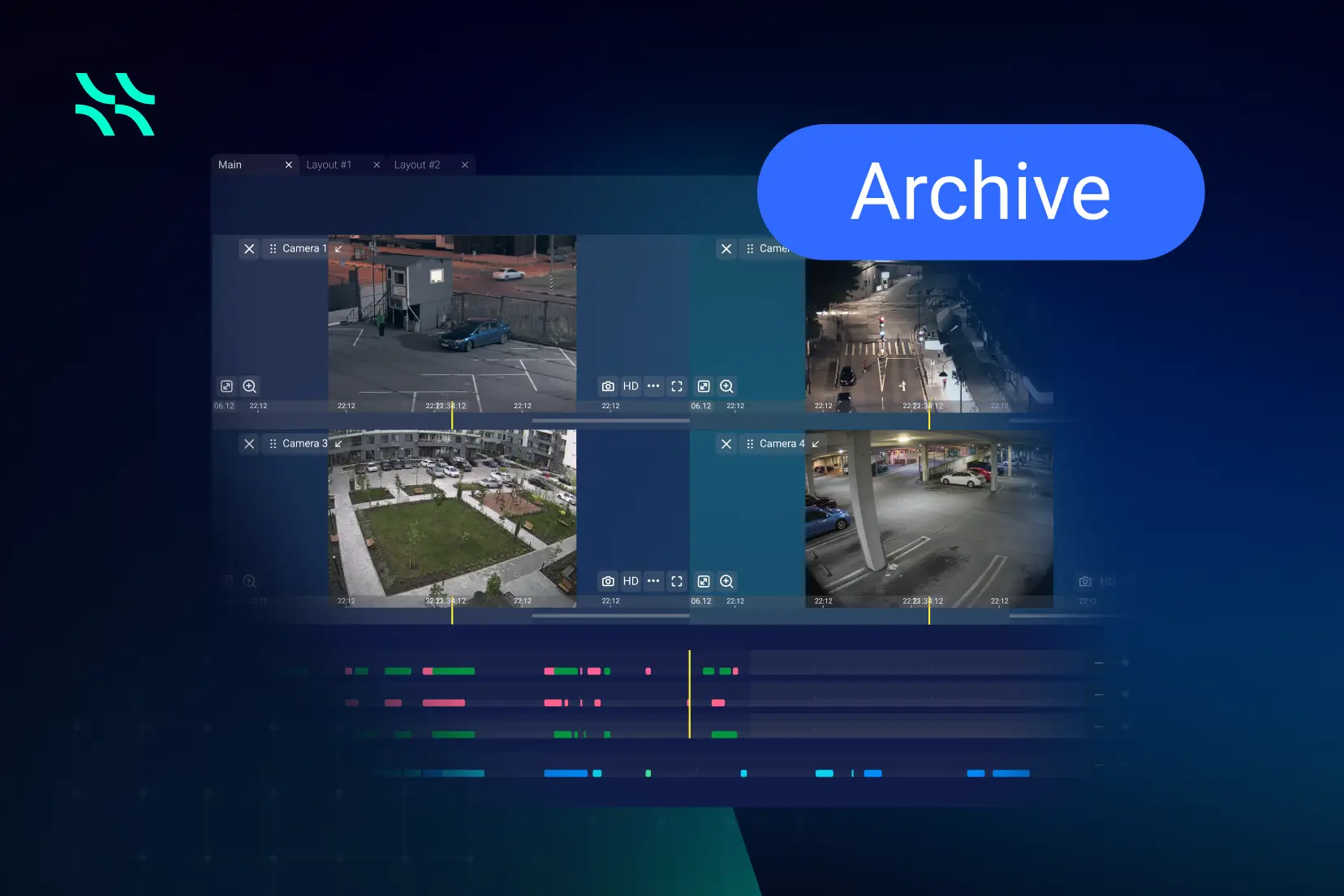
The demand for basic video surveillance service functionality is still growing actively: real-time monitoring and access to surveillance archive footage. When telecom providers deliver video surveillance as a service they ensure securely stored archive data. They locate data in the operator’s cloud infrastructure rather than on local devices. It provides greater reliability, scalability, and protection against hardware failures and thefts.
Archive retention, the length of time video footage stored, serves as the basic revenue driver and the operational cost in cloud video surveillance service provisioning. The Longer retention periods command the higher subscription prices. However, they also require significantly more storage capacity, which may increase infrastructure investments and operating expenses.
The key to profitable VSaaS is finding the right balance between customer expectations and storage efficiency.
Why archive retention drives both revenue and costs
For telecom operators, archive retention is one of the easiest ways to differentiate service tiers. Customers requiring 7, 30 or even 90 days of video history are typically willing to pay substantially more than those needing only a few days of storage. Yet every additional day of retention increases storage consumption almost linearly.
Let’s cover the correlation in the table, all number are average and exemplary for real data calculations contact our team.
| Recorded bitrate | Archive growth per day | Archive growth per 30 days | Revenue (exemplary numbers based on average data of cloud providers) $20/TB/month |
| 1 Mbit/s | 10.8 GB | 324 GB | $6.48/month |
| 2 Mbit/s | 21.6 GB | 648 GB | $12.96/month |
| 4 Mbit/s | 43.2 GB | 1.296 TB | $25.92/month |
| 10 Mbit/s | 108 GB | 3.24 TB | $64.80/month |
| 100 Mbit/s | 1.08 TB | 32.4 TB | $648/month |
| 1 Gbit/s | 10.8 TB | 324 TB | $6,480/month |
Scaling the needs growing the revenue and consumption for surveillance archive
While these numbers may appear manageable for a single camera, they scale rapidly. Let’s take as an example 4 Mbit/s = 1.296 TB per 30 days.
Storage requirement
| Retention period | 10 cameras | 100 cameras |
| 30 dias | 12.96 TB | 129.6 TB |
| 90 days | 38.88 TB | 388.8 TB |
| 180 days | 77.76 TB | 777.6 TB |
| 365 days | 157.68 TB | 1,576.8 TB (≈1.58 PB) |
Provider revenue estimate
Using $20/TB/month storage charge
| Retention period | 10 cameras revenue/month | 100 cameras revenue/month |
| 30 dias | $259/month | $2,592/month |
| 90 days | $778/month | $7,776/month |
| 180 days | $1,555/month | $15,552/month |
| 365 days | $3,154/month | $31,536/month |
These figures become even more significant once they consider storage redundancy. Depending on the architecture and level of data protection, redundancy typically increases total storage requirements by 20–50%, further impacting infrastructure costs.
This creates the central dilemma for telecom operators.
Customers in sectors such as retail, logistics, banking, manufacturing, and public infrastructure increasingly demand longer archive retention to satisfy compliance requirements, investigate incidents, and improve operational security. But longer retention also represents an attractive upselling opportunity, generating higher monthly recurring revenue.
At the same time, every additional retention day consumes more storage, increases infrastructure costs, and reduces service margins if storage not managed efficiently.
The challenge is no longer simply storing more video – it is storing it more intelligently.
A Smarter Approach to Surveillance Archive Monetization
Profitable archive monetization depends not only on the amount of storage available but also on how video is processed and recorded.
With the Aipix Platform, archive management is much more flexible. Every camera supports two independent video streams – HD and SD – which can be recorded independently according to business rules.
Instead of applying a single recording policy to every camera, operators can tailor archive strategies to each customer’s needs, optimizing both storage utilization and subscription value.
Consider a company operating dozens of small warehouses in remote locations. Continuous HD recording offers little additional value because footage rarely reviewed, while storage costs remain high.
Using flexible archive policies, the customer can record only motion-triggered events in SD quality, dramatically reducing storage consumption while preserving the footage that actually matters.
Also for sites requiring higher evidential quality, HD recording can be enabled only when predefined events occur, ensuring critical incidents are preserved without continuously consuming premium storage resources.
Flexible Archive Modes for Different Business Cases
The Aipix Platform supports several archive modes that allow telecom providers to match storage costs with customer requirements.
Resource Economy Mode (Smart SD Archiving)
Designed for maximum storage efficiency by recording only SD streams:
- Motion or analytics events
- Scheduled recording periods
This option minimizes storage requirements while retaining essential footage:
- Lowest storage consumption
- Longer retention periods possible
- Reduced infrastructure cost
- Suitable for:
- retail
- offices
- warehouses
- parking areas
- non-critical facilities
Precision HD Archiving
Ideal for environments where image quality matters only during important incidents:
- Record HD only when events occur
- Record HD during scheduled periods
This preserves high-quality evidence while avoiding continuous HD storage costs.
Hybrid Archive Mode
Combines efficiency with evidential quality.
Routine monitoring is archived in SD according to a schedule – for example, during business hours – while analytics or motion events automatically trigger HD recording. Customers receive complete coverage and telecom provider balance the storage consumption. Benefits:
- Best balance between cost and value
- Likely the strongest commercial offering
Full Dual-Stream Backup
For critical infrastructure, banking, or high-security facilities, both SD and HD streams are archived simultaneously, providing maximum redundancy, image quality, and operational resilience. Benefits:
- Enterprise/high-security tier
- Highest revenue per customer
- Suitable for:
- banks
- government
- critical infrastructure
- airports
- industrial sites
Turning Archive Flexibility into Higher Profitability
Archive retention will remain one of the strongest revenue drivers in cloud video surveillance. However, profitability is no longer determined solely by offering longer retention periods. It depends on how efficiently that archive is managed.
By granular control over recording quality, event-based recording, schedules, and dual-stream storage, Aipix enables telecom providers to reduce infrastructure costs while creating more differentiated service packages.
Instead of forcing customers to choose between long retention and affordable pricing, operators can deliver archive strategies tailored to each deployment – maximizing storage efficiency, improving customer value, and increasing recurring revenue at the same time.
Contact Aipix team to discover more opportunities of flexible archive management based on Aipix Platform, let’s find the most relevant and profitable options for your business.





 PT
PT  EN
EN  ES
ES  FR
FR  PL
PL