

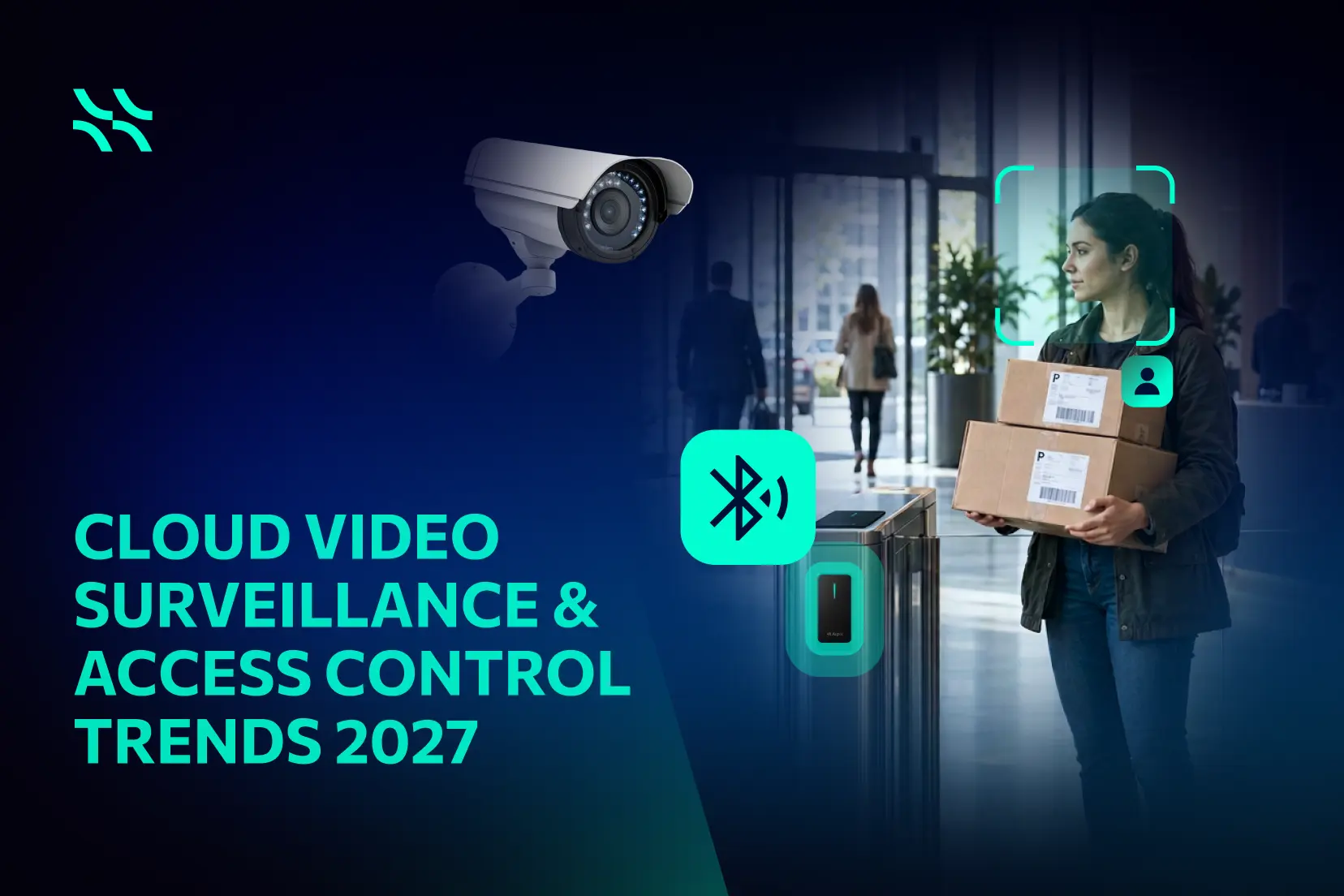
What are the VSaaS and access control trends 2027?
The VSaaS and access control trends 2027 translates market signals into practical considerations for companies planning or developing provider-led security services.
The market for video surveillance and access control is moving from standalone security systems toward connected, cloud-enabled services. For telecom operators, ISPs, cloud providers this shift creates new questions: What do customers expect from modern security services? Which deployment models should be supported? And how can video surveillance become a scalable, recurring service rather than a one-time project?
Why to learn cloud physical security 2027 in terms of video surveillance and access control trends?
1. Identify what customers will expect from security services
The report shows the shift from standalone surveillance toward connected services: remote access, integration, analytics, easier expansion, and centralized management. For example, 60% of surveyed respondents identified integration with new technologies as a reason for replacing legacy systems, while 51% cited access to new capabilities.
2. Find where VSaaS can fit into the existing service portfolio
The report explains how providers can build security as an additional recurring service alongside connectivity, cloud, and other offerings. It specifically highlights the ability to combine infrastructure, customer reach, recurring billing, and technical operations with a branded security service.
3. Understand which deployment models to offer
Rather than treating “cloud-only” as the universal answer, the report shows why hybrid cloud matters for customers that need local resilience, bandwidth control, or specific data-placement requirements. It also reports that 72% of consultants plan to specify hybrid deployments over the next five years.
4. Build services around customer segments
The report provides a practical framework for adapting the offer for residential, SMB, enterprise, and public-sector customers, including differences in onboarding, storage, support, cameras, retention, and analytics.
5. Turn video into a broader VAS portfolio
Providers can see how to move beyond basic video surveillance by adding video archive, analytics, access control, and other connected servic through one service foundation. This creates a roadmap for expanding the initial VSaaS offer as customer demand develops.
6. Understand the platform requirements before investing
The report identifies the capabilities needed to operate VSaaS at scale: multi-tenancy, flexible deployment, open APIs, OSS/BSS and billing integration, white-label applications, centralized operations, and service expansion. This makes the report useful not only for marketing teams but also for product and technology teams.
7. Get a practical go-to-market framework
Perhaps the most actionable part is the five-step playbook:
choose a target segment → design packages → run a pilot → build integrations → measure service health.
It gives providers a starting framework for moving from market research to an actual commercial service.
Download the full research on VSaaS and access control trends 2027
Get the Cloud Video Surveillance and Access Control Trends 2027 research to explore the market signals, customer expectations, deployment trends, and practical considerations that can help shape the next generation of provider-led security services.
Get your "Cloud video surveillance and access control trends 2027"
Leave your e-mail and we’ll send you the file





 EN
EN  ES
ES  FR
FR  PL
PL  PT
PT