

¿Es posible escalar un servicio de videovigilancia en la nube manteniendo una infraestructura flexible y eficiente en el uso de recursos?
A video surveillance media server sits at the center of workload. Every additional stream creates load across several infrastructure layers.
Aipix Mediaserver provides one example of how this type of infrastructure can be organized. Its architecture combines stream capture, recording, archive management, and media delivery within a single media-processing layer.
Depending on hardware and workload, one Mediaserver node can process up to 5,000 streams. However, stream count alone does not determine whether a deployment is efficient. Scalability also depends on how processing resources, storage, bandwidth, recording policies, and redundancy are designed.
¿Qué es un servidor multimedia de videovigilancia en la nube?
A video surveillance media server is a component that processes multimedia streams between cameras, storage systems, applications, and viewers.
Sus principales responsabilidades suelen incluir:
- recepción de transmisiones de vídeo y audio;
- Procesamiento de los medios entrantes;
- grabación de vídeo;
- gestión de archivos;
- proporcionar acceso a los vídeos almacenados;
- ofreciendo transmisiones en vivo;
- Entrega de vídeo archivado.
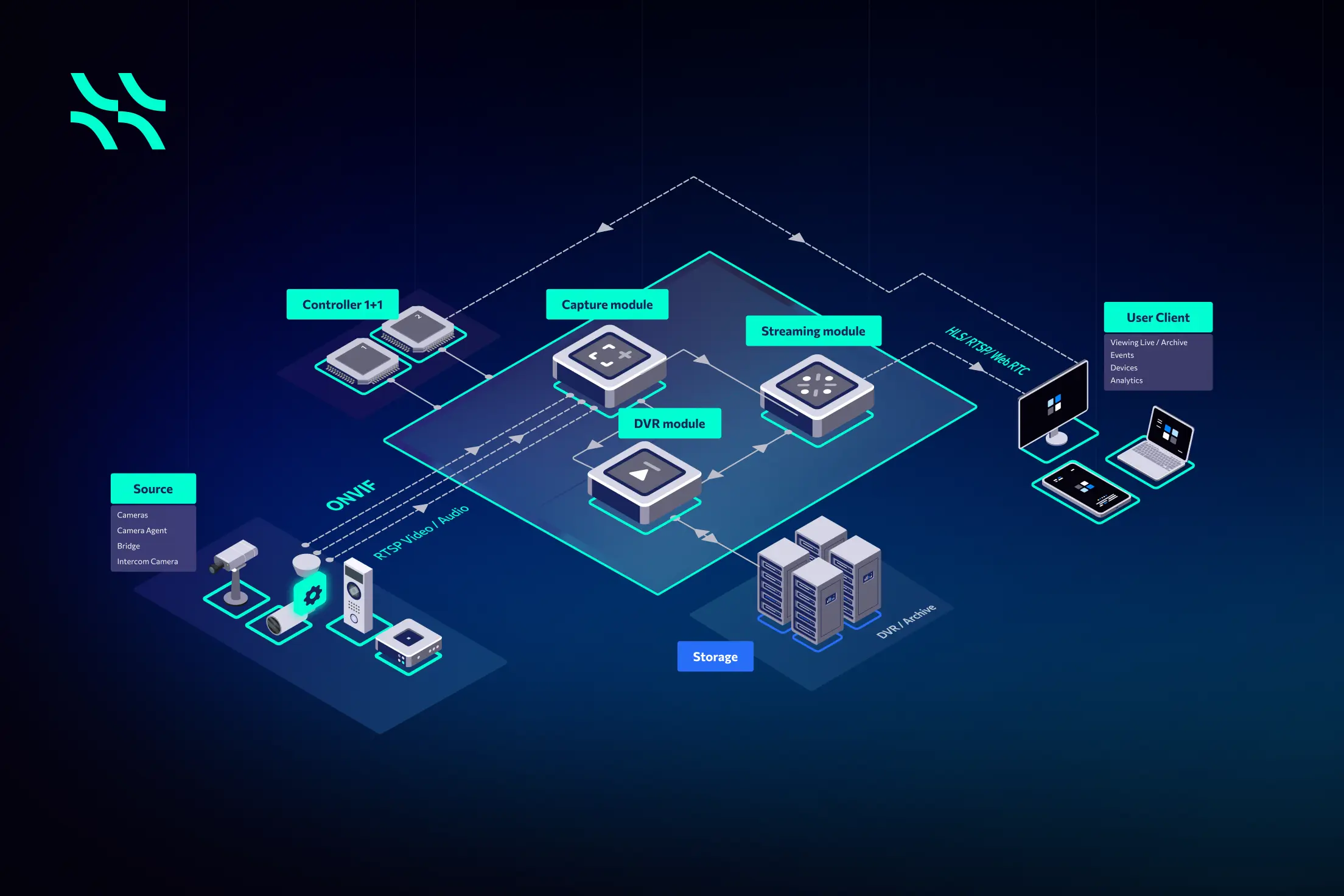
In Aipix Mediaserver, these functions are divided between several core components, including Capture, Streaming, and DVR.
The Capture component connects to cameras and other media sources and receives incoming streams. The DVR component manages recording and video archives. The Streaming component delivers both live and archived media to applications and users.
The overall media flow can be represented as:
Camera or stream source → Capture → RTP processing → Streaming and/or DVR → Video delivery
This architecture keeps the main media operations within one processing layer while separating the responsibilities of stream acquisition, recording, storage, and playback.
How does the Capture module process incoming streams?
Before video can be recorded or delivered to viewers, Mediaserver must establish and maintain a connection with the camera or another stream source.
This task is handled by the Capture module.
Capture provides an API for internal Mediaserver modules that need access to video streams and supports RTSP stream acquisition using both TCP and UDP transport.
Once a stream is received, Capture processes the incoming RTP packets, which carry the media data.
Two handlers are involved in this process:
- Streamer — created when a stream is added to Mediaserver. It processes incoming RTP packets and forwards them to the components responsible for video streaming.
- Recorder — created when recording is enabled for the stream. It processes the same incoming RTP packets and forwards them to the DVR/archive subsystem.
This architecture allows a single captured camera stream to be used for several purposes simultaneously.
For example, a live stream can be delivered to a user while the same stream is also being recorded into the archive.
Separating Capture from recording and playback also helps organize media-processing responsibilities as deployments grow.
¿Cuántas transmisiones puede procesar el servidor multimedia de videovigilancia?
According to the documented reference configuration, one Servidor de medios node can process up to 5.000 transmisiones de vídeo, dependiendo del hardware y la carga de trabajo.
Este procesamiento puede incluir la captura de la transmisión, la grabación de archivos y la entrega de contenido.
Para el escenario de referencia de 5000 flujos, la configuración aproximada de la infraestructura es:
- 32 vCPU;
- 160 GB RAM;
- 128 GB SSD;
- 2 × 10 Gbit/s network adapters;
- up to 3,000 TB HDD for 30 days of archive storage.
Estas cifras no deben interpretarse como requisitos fijos para cada implementación.
El consumo real de recursos depende de factores como:
- número de corrientes;
- tasa de bits de la cámara;
- resolución;
- códec;
- modo de grabación;
- período de retención;
- tamaño del archivo;
- número de espectadores;
- Tráfico de red entrante y saliente.
Esta distinción es importante al estimar los costos de infraestructura. Dos implementaciones con la misma cantidad de cámaras pueden requerir cantidades muy diferentes de procesamiento, almacenamiento y ancho de banda.
Escalabilidad del servidor multimedia de videovigilancia en función del aumento del número de cámaras.
La escalabilidad tiene dos dimensiones principales: aumentar la capacidad de un nodo existente y añadir más nodos.
Aipix Mediaserver admite ambos escalado vertical y horizontal.
El escalado vertical consiste en aumentar los recursos de un servidor individual, como la CPU y la RAM.
El escalado horizontal consiste en añadir más nodos de Mediaserver y distribuir la carga de trabajo entre ellos.
Las configuraciones de referencia documentadas ilustran cómo cambian los requisitos de hardware a medida que aumenta el número de flujos:
| Transmisiones de vídeo | vCPU | RAM | Red | Disco duro de referencia de 30 días |
|---|---|---|---|---|
| 200 | 4 | 16 GB | 1 Gbit/s | 60 TB |
| 500 | 8 | 48 GB | 2 × 1 Gbit/s | 300 TB |
| 1,000 | 12 | 64 GB | 10 Gbit/s | 600 TB |
| 2,000 | 16 | 80 GB | 10 Gbit/s | 1.200 TB |
| 5,000 | 32 | 160 GB | 2 × 10 Gbit/s | 3.000 TB |
The table demonstrates why stream count should be treated as a sizing input rather than the only scalability metric.
A medida que aumentan los despliegues, los diferentes recursos de infraestructura pueden incrementarse a ritmos diferentes.
For example, a larger number of viewers may increase outgoing network traffic without significantly changing archive storage requirements. A longer retention period may dramatically increase storage requirements without changing the number of incoming streams.
Fault tolerance and redundancy for VSaaS availability
Un sistema de videovigilancia a gran escala también debe tener en cuenta los fallos del servidor.
If thousands of camera streams depend on one processing node, a failure can affect a significant part of the service.
This is why fault tolerance and redundancy are important in multi-server environments.
Aipix Mediaserver puede funcionar con Controller en una configuración donde las cargas de trabajo se pueden redistribuir entre servidores. Si un servidor deja de estar disponible, las transmisiones se pueden redirigir a otro nodo disponible.
The practical value of this approach is not limited to backup.
Reduce la dependencia de un único servidor de procesamiento y permite considerar conjuntamente la planificación de la capacidad y la resiliencia.
En una implementación de mayor envergadura, los nodos adicionales pueden, por lo tanto, cumplir dos funciones:
- aumentar la capacidad de procesamiento;
- Mejorar la continuidad del servicio en caso de que falle otro nodo.
Para los operadores, esta es una distinción importante. La escalabilidad sin redundancia puede aumentar la capacidad, pero sigue dejando la plataforma vulnerable a fallos individuales de los servidores.
¿Cómo puede un servidor multimedia de videovigilancia ayudar a optimizar el almacenamiento?
El almacenamiento es uno de los requisitos de infraestructura más importantes en la videovigilancia en la nube.
La cantidad de almacenamiento necesaria depende en gran medida de la tasa de bits de la cámara, el modo de grabación, la compresión de vídeo, la actividad de la escena y el período de retención de los archivos.
La cifra de 3000 TB asociada a la configuración de referencia de 5000 flujos se basa en un escenario de archivo definido, en lugar de ser un requisito fijo para cada implementación.
El cálculo de referencia supone lo siguiente:
- aproximadamente 2 Mbit/s por flujo de vídeo;
- Grabación continua las 24 horas del día, los 7 días de la semana;
- 30 días de retención de vídeo.
Las diferentes estrategias de grabación pueden modificar significativamente los requisitos de almacenamiento.
Aipix Mediaserver admite varios modos de grabación de archivo, entre ellos:
- grabación continua;
- grabación bajo demanda;
- grabación basada en eventos;
- grabación programada;
- grabación atenuada.
This means operators can define archive policies according to the requirements of each camera or use case instead of applying the same recording model to every stream.
Continuous recording
With continuous recording, the video stream is archived without interruption.
This approach is suitable when operators need a complete visual history from a camera, but it also creates the highest storage requirements.
Recording on demand
On-demand recording starts and stops following a client request.
This can be useful when recording is required only for specific situations, investigations, or temporary monitoring tasks.
Scheduled recording
Scheduled recording activates archive recording according to a predefined timetable.
For example, a camera could be configured to record continuously during business hours but use another recording strategy outside those hours.
Thinned recording
Thinned recording reduces the amount of data written to the archive.
Several approaches can be used.
With continuous thinning, only key IDR frames are recorded.
In another configuration, full recording can start only when requested by a client.
Scene-activity-based recording provides another option. When there are no meaningful changes in the image, the system can record only IDR frames. When activity is detected in the scene, an event can trigger full-stream recording.
This makes it possible to reduce archive consumption while still preserving more detailed footage when something important occurs.
Grabación basada en eventos para reducir el uso innecesario de archivos.
Event-based recording is designed for scenarios in which continuous 24/7 recording is unnecessary but operators still need meaningful footage around an incident.
The challenge is that recording only from the exact moment when an event is detected can remove important context.
A person may enter the scene several seconds before motion detection is triggered, for example.
To solve this problem, Aipix Mediaserver maintains a rolling video buffer for streams configured for event-based recording.
Two parameters control the process:
- Stream depth (X) — determines how many seconds of recent video Mediaserver retains in the buffer. The supported range is 5 to 120 seconds.
- Timeout (Y) — determines how long Mediaserver continues recording after receiving an event trigger. The supported range is also 5 to 120 seconds.
As new video cycles arrive from the camera, they are written into the buffer.
Once the configured buffer depth is reached, the oldest data is removed as new video arrives. As a result, the buffer always contains the most recent period of footage.
When an event is triggered, Mediaserver checks whether archive recording for that stream is already active.
If recording is not active
Mediaserver extracts the footage currently stored in the buffer and places it at the beginning of the new archive recording.
It then continues recording the current live stream into the same archive file.
Recording continues for the configured post-event timeout.
The resulting archive can therefore contain:
Pre-event footage → Event → Post-event footage
For example, if the stream depth is configured to 30 seconds and the post-event timeout is 60 seconds, the archive can contain up to 30 seconds of video preceding the event and continue recording for 60 seconds after the event is received.
Before the recording ends, Mediaserver resumes filling the buffer so that pre-event footage is available again if another event occurs.
If recording is already active
If another event is received while recording is already in progress, Mediaserver does not need to start a completely separate recording.
Instead, the system extends the existing recording period by the configured timeout.
The point at which buffering resumes is also shifted accordingly.
This approach preserves useful event context while avoiding the storage consumption associated with continuous recording for every camera.
¿Qué códecs de vídeo y audio admite Aipix Mediaserver?
Codec support is important because surveillance networks often contain cameras and devices from different manufacturers and generations.
Aipix Mediaserver admite los códecs de vídeo más utilizados, entre ellos:
- H.264, also conocido as Advanced Video Coding (AVC) or MPEG-4 Part 10;
- H.265, also known as High Efficiency Video Coding (HEVC) or MPEG-H Part 2.
H.264 remains one of the most widely used codecs in video surveillance and provides a practical balance between compression efficiency, compatibility, and processing requirements.
H.265 can provide greater compression efficiency than H.264, potentially reducing the bandwidth and storage required for comparable video quality.
Las capacidades de audio documentadas incluyen:
- transcodificación de CAA;
- PCMA;
- PCMU;
- G.711.
In mixed-camera environments, codec support is particularly important because operators may use equipment from several manufacturers across different generations.
A media server that supports the codecs already used by the camera fleet can process streams without requiring operators to standardize every device on the same media format.
How does a surveillance media server deliver live and archived video?
Una plataforma de videovigilancia en la nube debe distribuir vídeo a diferentes aplicaciones, dispositivos y entornos de usuario.
La Streaming module in Aipix Mediaserver is responsible for delivering both live streams and archived video.
It supports several playback technologies:
- RTSP Live — live video streaming via RTSP;
- RTSP DVR — archived video playback via RTSP;
- HLS Live — live video streaming via HLS;
- HLS DVR — archived video playback via HLS;
- WebRTC Live — low-latency live video delivery;
- WebRTC DVR — archive playback via WebRTC;
- archive export using fragmented MP4;
- archive export as TAR.
Using several delivery protocols gives applications flexibility in how video is presented to users.
RTSP
RTSP, or Real-Time Streaming Protocol, is commonly used to establish and manage media-streaming sessions.
It is widely used within professional video and surveillance environments and supports operations such as playback, pause, stop, and navigation through recorded media.
HLS
HLS provides HTTP-based media streaming and can be used for both live and archived video playback.
It is particularly useful in environments where video needs to be delivered through web infrastructure or to a wide range of client devices.
WebRTC
WebRTC enables real-time audio, video, and data transmission between applications and browsers.
Its low-latency characteristics make it suitable for scenarios where minimizing the delay between camera capture and user playback is important.
Different protocols can therefore be selected according to application architecture, latency requirements, network environment, and playback scenario.
Live and DVR player handlers
Internally, the Streaming module uses dedicated handlers for different playback scenarios.
HLS Live, RTSP Live, and WebRTC Live handlers process requests for real-time video.
HLS DVR, RTSP DVR, and WebRTC DVR handlers process requests to view footage stored in the archive.
For archive playback, the DVR player retrieves the required RTP packets according to the requested stream identifier and timestamp.
This allows users to navigate through recorded footage without establishing a new capture session with the original camera.
The same Mediaserver infrastructure can therefore support both live viewing and archived playback while keeping Capture, storage, and playback responsibilities separate.
How does Mediaserver manage video archives?
Recording video is only one part of archive management.
As archive size grows, the system also needs to determine:
- how recordings are segmented;
- where they are stored;
- how long they remain available;
- when old data should be removed;
- how footage can be retrieved and exported.
La DVR module handles these responsibilities.
By default, DVR recordings are created in two-minute segments. The recording duration can be adjusted when the stream is configured through Controller.
Recorded data is automatically stored in the configured local storage directory.
Retention settings define how long archived footage remains available. When the retention period expires, older recordings can be automatically deleted so that storage can continue to be used for newer footage.
The archive can also be completely deleted following a client request.
Archive quotas and recording policies provide additional mechanisms for controlling storage consumption.
For large VSaaS deployments, this makes archive management a fundamental infrastructure capability rather than only a playback feature.
Which archive formats can be exported?
Surveillance footage often needs to be used outside the primary video platform.
Operators may need to provide footage for investigations, share it with third parties, create short previews, or transfer recordings into another system.
Aipix Mediaserver supports several archive export formats.
MP4
MP4 is one of the most widely supported video container formats.
It is suitable when recorded footage needs to be played using common desktop, mobile, and media applications or shared outside the surveillance platform.
fMP4
Fragmented MP4, or fMP4, divides media into smaller fragments.
It is particularly useful in streaming-oriented architectures because individual fragments can be processed and delivered without waiting for an entire media file to be completed.
Snapshot MP4
Snapshot MP4 provides access to selected moments within recorded material.
It can be useful when operators need quick access to a particular point or event without reviewing the entire archive.
Preview MP4
Preview MP4 provides a shorter representation of recorded material and can help users assess footage before opening or exporting the complete recording.
Raw archive
Raw archive export preserves the archive data in its original stored representation.
This can be useful for workflows in which the original media data needs to be retained for further processing, analysis, migration, or specialized examination.
Supporting multiple export formats allows archive storage and external video usage to remain separate concerns.
Operators can keep footage inside an archive structure optimized for the platform while exporting it into a format appropriate for users or downstream applications.
Playback of DVR recordings without recapturing the camera stream
One important characteristic of the DVR architecture is that archived footage can be played independently of the current camera capture session.
When a user requests historical footage, the DVR player loads the required data from the archive according to the stream and requested timestamp.
The system does not need to reconnect to the camera and recapture the original footage.
This is particularly important in large video surveillance environments because archive playback can create substantial user traffic of its own.
Separating historical playback from camera capture reduces unnecessary interaction with cameras and allows stored footage to be delivered directly from archive infrastructure.
Can a video surveillance media server use different storage resources?
La capacidad de procesamiento y el almacenamiento no necesariamente crecen al mismo ritmo.
A deployment with many cameras and a short retention period may require significant processing capacity but relatively limited archive storage.
Otra implementación podría procesar menos transmisiones, pero conservar las grabaciones durante mucho más tiempo.
Aipix Mediaserver admite el almacenamiento DVR configurable mediante ubicaciones de almacenamiento físico y puntos de montaje definidos.
Esto permite planificar la infraestructura de almacenamiento de forma independiente de los recursos de CPU y memoria utilizados para el procesamiento de flujos de datos.
Separating these requirements can make infrastructure planning more flexible.
Compute capacity can be increased as stream-processing demand grows, while storage can be expanded according to archive depth, camera bitrate, and recording policies.
Cost-efficiency of VSaaS with a video surveillance media server
There is no single configuration that makes every video surveillance system cost-efficient.
Efficiency comes from matching different infrastructure resources to the workloads they actually support.
Por ejemplo:
- La capacidad de procesamiento debe ajustarse al volumen y la complejidad del flujo de datos;
- El almacenamiento debe cumplir con los requisitos de registro y retención;
- La capacidad de la red debe ajustarse al tráfico multimedia entrante y saliente;
- Los modos de grabación deben reflejar la importancia operativa de cada flujo;
- delivery technologies should match application and latency requirements;
- redundancy should reflect service-availability requirements.
Recording policy can have a particularly significant impact on infrastructure costs.
A camera that records continuously generates a very different storage workload from a camera using event-based or thinned recording.
Likewise, an installation with relatively few cameras but many concurrent viewers can create a higher outgoing bandwidth requirement than a much larger camera deployment with limited live viewing.
This is why a video surveillance media server should be evaluated as part of a broader architecture rather than by stream capacity alone.
A server capable of processing thousands of streams is valuable, but the overall deployment still depends on how efficiently capture, storage, networking, recording, playback, and failover are configured.
Building a scalable video surveillance service
El principal desafío en la videovigilancia en la nube no es simplemente admitir más cámaras.
Gestiona la carga de trabajo combinada generada por esas cámaras.
Cada flujo afecta al procesamiento, la red, el almacenamiento, la gestión de archivos y la distribución de vídeo.
A medida que aumentan las implementaciones, estos requisitos se interconectan cada vez más.
A well-designed video surveillance media server architecture therefore needs to provide more than high stream capacity. It should allow processing, storage, bandwidth, recording policies, and redundancy to scale according to their own requirements.
Aipix Mediaserver illustrates this approach by combining stream capture, RTP processing, archive recording, media delivery, flexible recording modes, storage management, archive export, and multi-server scaling within one media-processing layer.
The separation of Capture, Streaming, and DVR functions also helps create a predictable media workflow:
Camera → Capture → RTP processing → Live streaming and/or archive recording → Storage → Playback or export
For VSaaS infrastructure planning, the key lesson is broader than any individual product.
Efficient scalability comes from understanding the complete media workload and scaling each resource according to actual demand.
To learn more about Aipix Mediaserver capabilities for efficiently launching and scaling a video surveillance service, contact the Aipix team for a detailed presentation.
Para obtener más información sobre las capacidades de Aipix Mediaserver para el lanzamiento y la escalabilidad eficientes del servicio de videovigilancia, póngase en contacto con nuestros gerentes para una presentación detallada.





 ES
ES  EN
EN  FR
FR  PL
PL  PT
PT