

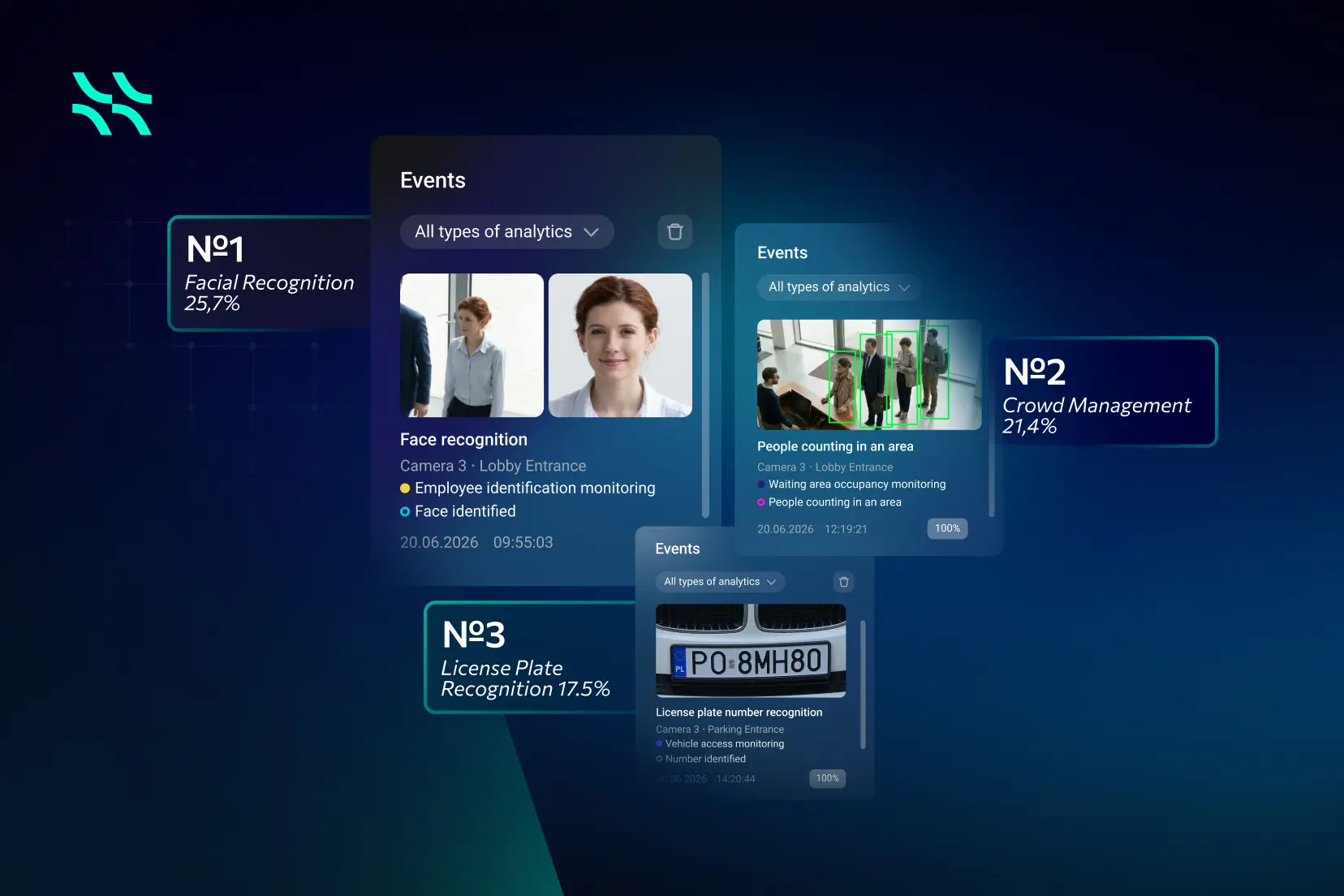
After successful launch and monetisation of cloud video surveillance telecom operators and ISPs next logical step is to upsell the offerings with Análisis de vídeo basado en IA. As a result, subscribers turn their cloud video surveillance systems into business tools for actionable insights. The insights presented can provide solutions for real operational challenges and improve efficiency.
At the same time, Telcos and ISPs have major opportunities of Análisis de vídeo basado en IA services like upselling for existing clients and attracting new ones with smarter solutions and added value.
The top 5 AI-powered video analytics use cases driving market demand
Surprisingly, most of the demand among businesses is not focusing on some specific cases. According to research data, businesses mostly consume the following analytics scenarios, which really are basic and meet a wide range of needs.
Face Recognition (25.7%) as leading AI-powered video analytics
Face recognition remains the largest segment of commercial video analytics because it combines security, automation, and customer management within a single technology.
Its value extends far beyond identifying individuals.
Fraud prevention
Retailers, banks, and commercial facilities use facial recognition to detect known offenders, repeat fraudsters, or individuals included in internal watchlists. Instead of relying on employees to recognize suspicious visitors, the system automatically generates alerts when predefined matches occur.
Gestión de acceso
Corporate offices increasingly replace traditional access cards with biometric identification. Employees can enter authorized areas without physical credentials, reducing card administration while improving security.
Workforce management
Facial recognition simplifies attendance tracking and shift verification. Because identification is automated, organizations reduce administrative workload while minimizing opportunities for time fraud.
VIP and customer recognition
Hotels, premium retailers, and service businesses use whitelists to recognize loyal customers or VIP visitors, enabling personalized service and improving customer experience.
The commercial value of facial recognition lies in its ability to combine multiple operational processes into a single AI-driven workflow.
Crowd Management (21.4%)
Crowd analytics has evolved from a public safety application into an important business intelligence tool. It usually include counting visitors and objects in the area.
Retail optimization
Store managers can identify peak traffic periods, optimize staff allocation, and redesign layouts based on actual customer movement rather than assumptions.
Public safety
Transport hubs, stadiums, airports, and event venues use crowd analytics to identify abnormal gatherings before congestion becomes a security risk.
Operational planning
Historical occupancy data allows organizations to forecast visitor behavior and allocate resources more efficiently.
License Plate Recognition (17.5%)
Automatic License Plate Recognition (ALPR/LPR) has become one of the fastest-returning investments in commercial video analytics because it directly automates vehicle-related processes.
Automated access control
Residential communities, office parks, logistics centers, and industrial facilities can replace manual gate operation with automated vehicle identification.
Authorized vehicles enter without human intervention, while unauthorized vehicles trigger alerts.
Parking management
Commercial parking operators reduce waiting times while improving customer experience through frictionless vehicle identification.
Logistics automation
Distribution centers use LPR to record arrival and departure times, automate documentation, and improve fleet visibility.
For telecom operators, LPR represents an attractive upselling opportunity because it delivers immediate operational savings for customers.
Zone Intrusion Detection (15.0%)
Perimeter protection has traditionally depended on physical barriers, motion sensors, and security personnel.
AI-based intrusion detection significantly improves this model by analyzing video streams in real time.
Virtual zones are configured around sensitive areas, and the system generates alerts only when predefined intrusion conditions are met.
Typical deployments include:
- Construction sites
- parques solares
- Energy infrastructure
- almacenes
- Instalaciones de fabricación
- Data centers
- Critical national infrastructure
Unlike conventional motion detection, AI algorithms distinguish between people, vehicles, animals, weather conditions, and environmental movement, dramatically reducing false alarms.
This reduction in false positives is often the primary reason organizations migrate from traditional video monitoring to AI-powered analytics.
Line Crossing Detection (12%)
Line crossing detection is frequently underestimated because of its simplicity.
In practice, it solves numerous security and operational problems with minimal configuration.
Virtual lines can be established across entrances, restricted corridors, loading docks, or perimeter boundaries.
The system then generates alerts only when movement crosses these predefined boundaries according to configured rules.
Applications include:
- Office security outside business hours
- Warehouse protection
- Residential property monitoring
- Restricted industrial areas
- Emergency exit monitoring
Because implementation requires little calibration, line crossing detection is often among the first analytics services deployed by managed service providers.
Why unified platforms provide a commercial advantage for AI-powered video analytics
The most efficient deployment like based on Aipix platform model combines cloud video surveillance and analytics within one platform.
Instead of treating analytics as a separate product, operators can activate AI modules directly within existing customer deployments.
This approach offers several business advantages:
- Existing cameras remain in operation.
- Analytics become additional subscription services.
- Deployment time decreases significantly.
- Training requirements are reduced.
- Customer management remains centralized.
- New AI modules can be introduced without rebuilding the service architecture.
For telecom operators, this creates a scalable model for expanding managed video services while minimizing operational complexity.
Conclusión
Cloud video surveillance alone is becoming a mature, price-driven service. Sustainable revenue growth increasingly depends on delivering intelligence rather than simply storing video.
Current market demand demonstrates that organizations are prepared to invest in analytics that solve specific operational problems – from biometric access control and vehicle automation to perimeter protection and crowd monitoring.
For telecom operators and ISPs, the opportunity is clear. Video analytics transforms existing surveillance infrastructure into a portfolio of high-value, subscription-based services that increase ARPU, strengthen customer retention, and create new revenue streams without requiring large-scale hardware replacement.
The providers that integrate AI-powered analytics into their managed video offerings today will be better positioned to compete in a market where customers expect actionable insights – not just recorded footage.
Connect with our team to explore the wide range of opportunities available for your telecom business through Aipix-based video analytics as a service platform.





 ES
ES  EN
EN  FR
FR  PL
PL  PT
PT