

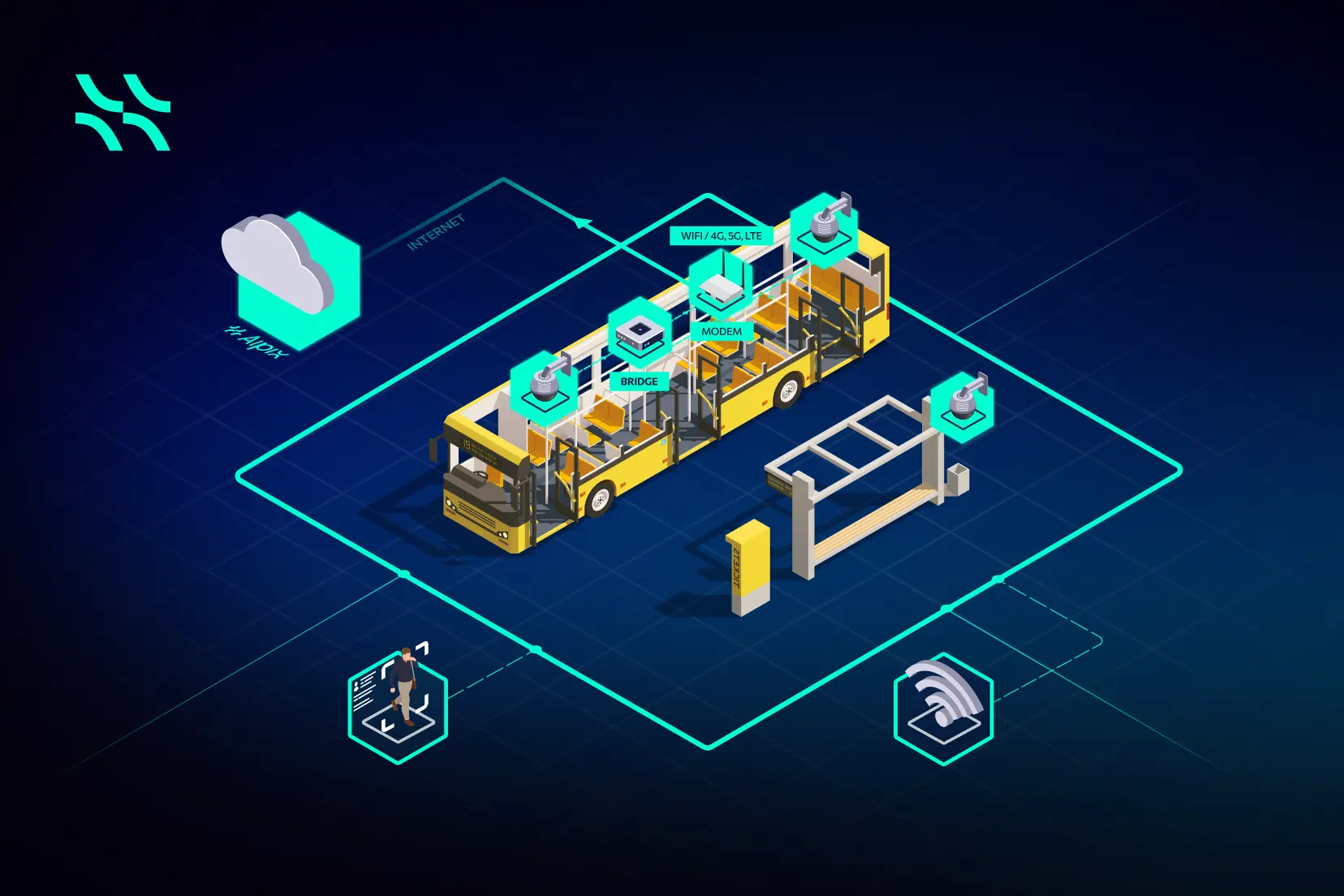
What does public transport video surveillance solution include?
Public transport video surveillance combines IP cameras, edge, and cloud video management to create a centralized monitoring environment across transport facilities.
Unlike surveillance at a single building, public transportation video surveillance has to work across distributed locations and moving vehicles. A bus or tram may travel through areas with different network conditions, while cameras at stops and stations remain connected to fixed infrastructure.
An edge-to-cloud architecture addresses this difference by combining local recording and viewing with centralized cloud access, archive management, and real-time monitoring.
How does public transport video surveillance work at bus and tram stops?
How can a city monitor a large number of distributed stops without managing each location as an isolated surveillance system?
Cameras installed at bus and tram stops can monitor:
- passenger waiting areas;
- vehicle arrival and departure zones;
- surrounding areas;
- transport infrastructure;
- incidents requiring operator attention;
- vandalism or damage.
When these cameras connected to a centralized public transport video surveillance platform, authorized personnel can access live video and recordings from multiple locations through one environment.
In addition this approach also makes it possible to organize cameras by location, transport facility, or other operational structures and connect video monitoring with additional services where required.
The result is a surveillance infrastructure that covers not only vehicles but also the places where passengers enter, leave, and wait for public transportation.
How can public transport video surveillance work inside moving vehicles?
How can video surveillance continue operating when a bus or tram moves through areas with weak or temporarily unavailable connectivity?
This is one of the main technical requirements for onboard surveillance.
Aipix Bridge provides an edge layer between onboard IP cameras and the cloud video surveillance platform. It enables standalone operation and synchronization of video and audio data with the cloud under variable connection conditions while keeping the required local infrastructure compact.
In fact, Bridge can connect up to 8 IP cameras and supports cameras from 2 MP to 8 MP, as well as H.265 and H.264 video codecs. It supports RTSP and ONVIF camera connections and audio through G.711 μ-law, G.711 A-law, and AAC codecs.
So this gives transport operators flexibility when designing or extending onboard surveillance infrastructure.
What happens to video when a vehicle loses its network connection?
Can Videovigilancia en el transporte público continue recording if the vehicle temporarily loses its connection to the cloud?
Yes. Local recording allows the vehicle to continue collecting video when the connection is unavailable. Once connectivity restored, the locally recorded archive can synchronize with the cloud.
When connectivity available, video can also be transmitted to the cloud for remote access and real-time monitoring.
This approach separates two requirements that are often difficult to satisfy with a purely cloud-based architecture:
- continuous local video recording, even during connectivity interruptions;
- centralized cloud access, when the connection is available.
For a moving vehicle, this means that temporary network degradation does not automatically result in a gap in the locally recorded footage.
How Does Bridge Connect Cameras in Public Transportation Vehicles?
Bridge designed to connect IP cameras through the vehicle’s local network. System can discover ONVIF-compatible cameras on the local network, while RTSP provides another option for connecting cameras by configuring their stream addresses.
For supported ONVIF cameras, the integration can also provide functions such as PTZ control and supported camera events.
Bridge provides a 10/100/1000 Mbps Ethernet interface, allowing it to connect to the local network infrastructure used in the vehicle.
This architecture also allows compatible existing IP cameras to be integrated instead of requiring the complete replacement of the onboard camera system.
How can operators monitor public transport video in real time?
What happens when the vehicle has sufficient connectivity?
Video can be transmitted to the cloud for real-time monitoring.
Authorized personnel can access live video from a vehicle to verify situations without waiting for it to arrive at a depot or station.
Real-time Videovigilancia en el transporte público can support monitoring of:
- incidents inside passenger compartments;
- emergency situations;
- suspicious activity;
- vehicle damage;
- operational events;
- situations requiring remote verification.
Bridge-connected cameras can be accessed through the platform’s available interfaces, including web, desktop, and mobile applications, according to user permissions.
This connects onboard video with the wider surveillance environment instead of keeping vehicle cameras isolated from the operator’s central system.
How can drivers use local video monitoring?
How can a driver view selected onboard cameras without depending on the cloud connection?
A local video viewing station can be provided inside the vehicle.
The driver can use the station to view selected camera feeds and gain visibility of areas that may not be directly observable from the driver’s position.
This local capability complements centralized Videovigilancia en el transporte público.
The driver receives local access to relevant video, while authorized transport personnel can simultaneously use the cloud platform for remote monitoring and archive access.
What value does public transport video surveillance provide to cities?
What does this technical infrastructure provide to a city beyond simply recording video?
For cities and transport operators, public transportation video surveillance creates a centralized source of visual information across vehicles and fixed transport facilities.
How can it support incident response?
Live video can help transport personnel verify what is happening during an incident.
Instead of relying only on information from a driver, passenger, or third party, authorized personnel can access visual information and assess the situation remotely.
This can be particularly useful when an incident occurs inside a moving vehicle or at a remote stop.
How can video help investigate incidents?
Recorded video can support the investigation of events such as:
- accidents;
- vandalism;
- damage to vehicles or infrastructure;
- passenger disputes;
- incidents at stops;
- events inside passenger compartments.
Local recording combined with cloud synchronization is particularly relevant when the network connection is interrupted during an event.
How can it improve monitoring of passenger areas?
Cameras at stops and inside vehicles extend the areas that transport personnel can monitor.
Instead of relying only on physical personnel at each location, a centralized system gives authorized users remote access to multiple cameras.
This creates a more consistent monitoring environment across a distributed transportation network.
How can public transportation video surveillance support operations?
Video can also provide operational information beyond security.
Transport operators can use recordings to investigate events, verify situations, monitor infrastructure, and understand what happened at a particular location or during a particular journey.
Where video analytics are introduced, selected events can be detected automatically and presented as notifications rather than requiring personnel to continuously watch every camera.
What are the technical advantages of public transportation video surveillance?
Why is an edge-to-cloud architecture suitable for public transportation?
The main technical advantage is that local and cloud components can perform different functions.
What does the edge layer handle?
The edge layer, represented by Bridge, operates close to the onboard cameras.
It can provide:
- local video and audio recording;
- operation during temporary connection loss;
- synchronization of local archive data with the cloud;
- real-time transmission when connectivity is available;
- local video viewing;
- camera connectivity through RTSP or ONVIF.
This reduces the dependence of onboard recording on a permanent cloud connection.
What does the cloud layer provide?
The cloud provides centralized management of the distributed public transportation video surveillance infrastructure.
Depending on the deployment, authorized users can access video from:
- buses;
- trams;
- bus and tram stops;
- stations;
- terminals;
- depots;
- other connected facilities.
The cloud therefore becomes the central management and access layer, while the edge device handles important local functions inside the vehicle.
How does the architecture handle variable connectivity?
A moving vehicle can encounter different network conditions along its route.
The architecture therefore does not treat the cloud connection as the only place where video can exist.
When connectivity is available, video can be transmitted for centralized access. When connectivity is interrupted, local recording continues. Once the connection returns, the archive can synchronize.
This combination allows the surveillance system to adapt to the actual network conditions encountered during vehicle operation.
How can a public transportation video surveillance project be realized?
How does an operator move from individual cameras to a connected surveillance infrastructure?
A project can be implemented progressively, beginning with a defined group of vehicles and transport facilities.
What should be assessed before deployment?
The first stage is an assessment of the existing infrastructure.
This includes:
- vehicles requiring onboard cameras;
- stops and stations requiring surveillance;
- existing IP cameras;
- camera compatibility;
- available network infrastructure;
- expected connectivity conditions;
- archive requirements;
- live-monitoring requirements;
- local driver-monitoring requirements.
This assessment determines where fixed cameras, onboard cameras, and edge infrastructure are required.
How are cameras installed and connected?
At fixed transport locations, cameras can connect to the available network infrastructure.
Inside vehicles, cameras are connected to Bridge through the local network.
Where existing IP cameras support the required interfaces, they can potentially be integrated through RTSP or ONVIF rather than being replaced.
This can allow an operator to introduce centralized public transport video surveillance while retaining compatible existing equipment.
How is bridge deployed in a vehicle?
Bridge is installed inside the vehicle and connected to the onboard network.
Up to eight IP cameras can be connected to one Bridge.
The cameras can then be added to the cloud video surveillance platform, creating a connection between the onboard camera infrastructure and the centralized system.
How is the system tested under real transport conditions?
Why is network testing an important part of the deployment?
Because connectivity can change along a vehicle’s route, the pilot should test the system under different conditions, including:
- stable connectivity;
- reduced bandwidth;
- temporary connection loss;
- continued local recording;
- connection restoration;
- archive synchronization;
- real-time video transmission.
These tests verify that local and cloud functions work as expected under the network conditions the vehicle actually encounters.
How is local driver monitoring added?
If driver monitoring is required, a local video viewing station can be installed inside the vehicle.
Selected camera feeds can then be displayed locally while the remaining surveillance infrastructure continues to operate through the cloud platform.
How can the project scale across a city?
Does a pilot have to be limited to a small number of vehicles permanently? No. The same architecture can be extended after the initial deployment.
An operator can progressively add:
- additional buses and trams;
- more stops;
- stations and terminals;
- depots;
- additional camera groups;
- additional monitoring and analytics scenarios.
This makes it possible to develop public transportation video surveillance as a common infrastructure across the transport network rather than deploying independent systems for every new location.
How can public transport video surveillance support a connected transport network?
What happens when cameras, edge infrastructure, and cloud services become part of the same transport environment?
The result is more than a collection of cameras.
Fixed cameras can monitor stops and other facilities. Onboard cameras can provide visibility inside vehicles. Bridge can maintain local video operation when connectivity changes. The cloud can provide centralized access and management, while analytics can add automated event detection where required.
For cities and transport operators, this creates a technical foundation for centralized video monitoring across a distributed transportation network.
For citizens, the practical value is a more consistently monitored environment across vehicles and passenger facilities.
From the technical perspective, the combination of local recording, real-time transmission, automatic cloud synchronization, flexible IP camera integration, and centralized management addresses a key requirement of transportation surveillance: keeping video available despite changing network conditions.
Public transportation video surveillance can therefore be built as a scalable edge-to-cloud infrastructure that connects vehicles, stops, and other transport facilities while allowing local and centralized video functions to work together.
Looking to launch cloud-based physical security services in various network environments? Contact us for in-detail presentation.





 ES
ES  EN
EN  FR
FR  PL
PL  PT
PT