

Rapid launch of smart intercom service via SIP without API integration
When launching a smart intercom service on sites with already installed equipment, one limitation may appear. Devices have not yet been integrated to the VSaaS Platform via an API. Integration, where possible, may take time and require investment.
In such cases, it is possible to set up the service with Platforma Aipix via the standard SIP protocol. But the intercom equipment should support SIP and pass. a compatibility test. Without API integration, the intercom system connects to the platform as a SIP-compatible video device. Nevertheless it does not replace full API integration and may limit some automation and advanced features.
However this scenario retains a key user function: answering a call from the intercom and opening the door via a mobile app.
So it enables telecom provider to launch and monetise the service rapidly at sites where panels already installed. They can do it without full integration or replacement of equipment at the outset. Also they can assess demand and the service’s viability, and then, if necessary, move on to deeper integration or expanded functionality.
How smart intercom service via SIP integration with the Aipix platform works
SIP-enabled smart intercom hardware setup
This approach does not require any special modifications from the intercom equipment manufacturer. Providers can apply it to various intercom panel models, provided they support the necessary SIP scenarios and network connection settings.
The intercom is configured manually via its administration panel in accordance with the parameters generated by the platform. Once configured, the intercom registers with or connects to the Aipix platform’s SIP infrastructure and initiates a call when a button on the panel is pressed. The user receive an incoming video call via the Aipix mobile app, fully branded to the mobile operator. Unlike API integration, the platform does not control the device directly. All key actions perform within the SIP script:
- the call from the intercom arrives via SIP;
- audio and video are transmitted within the SIP session via RTP;
- the user answers the call in the mobile app;
- the door is opened by sending a DTMF command during the active SIP session.
How the intercom works as a SIP device
In this scenario, the intercom is configured as a generic SIP device. The call button is pressed. Them it dials the flat number which corresponds to a pre-defined SIP number, user or group of users. Video is transmitted within the SIP call as video media, negotiated via SDP.
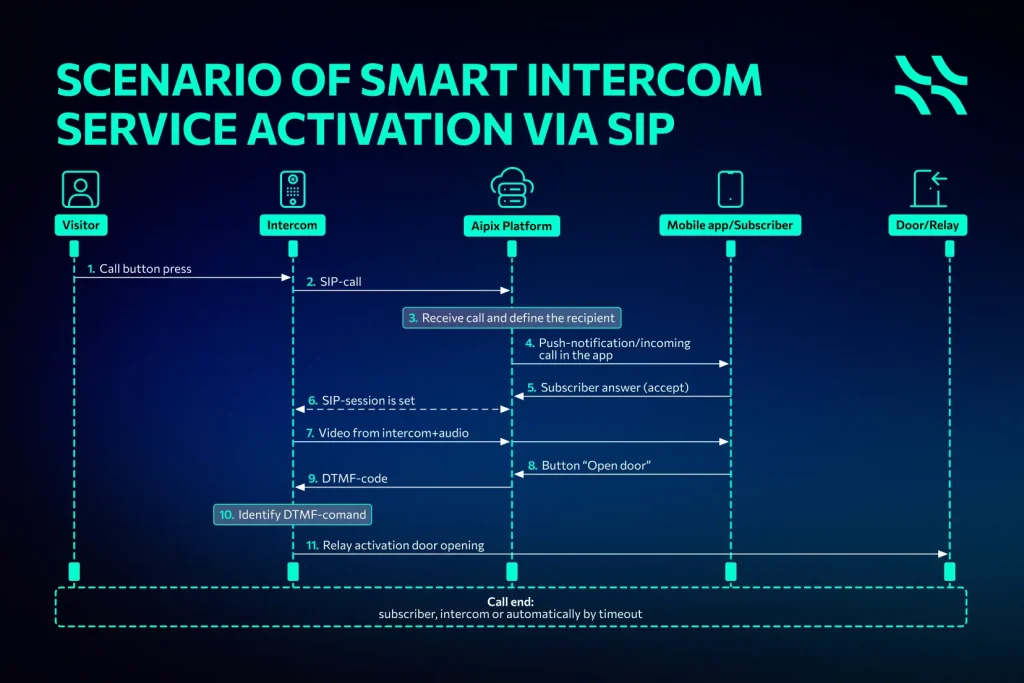
Call scenario
- A visitor presses the call button on the doorphone.
- The doorphone initiates a SIP call to the platform.
- The platform accepts the call and determines to whom it to route.
- The user receives a push notification or an incoming call in the mobile app.
- Once the user answers, a SIP session established.
- The user sees the video feed from the door entry system and hears the audio.
- The ‘Open Intercom’ button pressed. The app sends a DTMF code to the door entry system via the platform.
- The intercom recognises the DTMF command and activates the door-opening relay.
- The call terminated by the user, the intercom, or automatically upon a timeout.
Key requirements and limitations of the SIP approach
When using SIP integration, the following points must be taken into account:
- the door only opens during a SIP call if the intercom requires an active session for DTMF transmission;
- there is no separate API for checking the status of the door or the relay;
- video quality and format depend on the SIP capabilities of the specific intercom;
- the device must approve the supported method of DTMF transmission
Benefits for the telecom provider of smart intercom service via SIP activation
Rapid service roll-out. Provider shouldn’t wait for the upgrade or approval of API integration from device manufacturer. Once they have checked compatibility and configured the SIP parameters, they can connect the device using a standard setup.
Scalability based on a repeatable activation model. Connection of SIP-compatible intercom systems via a standardised procedure reduces reliance on individual integration projects for each piece of equipment.
Less reliance on the manufacturer’s API. The service’s core functionality is based on standard SIP mechanisms, so changes or restrictions to the API have less impact on the key scenario — calling and opening the door.
Monetisation of existing infrastructure. The operator can launch the service on existing equipment, assess demand more quickly and commence commercial operation without the need for mandatory site upgrades.
Reduced connection costs. The fact that there is no need to replace intercom panels straight away makes the project more attractive to property management companies, developers and property owners.
Further development of the smart intercom service
SIP integration can serve as the first step towards launching a smart intercom system. Then the operator can then either retain the basic setup or move on to deeper integration via API, enabling temporary access codes, visitor logs, device monitoring, viewing missed calls and other advanced features.
It is also possible to gradually replace existing panels with new ones already integrated to the Aipix platform, expanding the service’s functionality and increasing its value for subscribers.
Wniosek
SIP integration helps an operator or internet service provider to bring a smart intercom service to market more quickly, utilise existing infrastructure and begin monetisation without having to replace equipment at the outset.
Have an existing intercom infrastructure with strong growth potential, or looking to launch a new smart intercom service? Connect installed SIP-enabled intercoms for a fast time-to-market, or choose from a range of intercom models already API-integrated with the platform for access to advanced smart intercom features from day one.





 PL
PL  EN
EN  ES
ES  FR
FR  PT
PT