

How to package more value into video surveillance service? Combining video analytics and archive
When presenting video surveillance service opportunities – video archive and analityka are usually positioned like storage tool for rewinding footage and tool for event alerting push-notification.
But this approach leaves much of the value of video data untapped. When video analytics and archive search work together, recorded footage becomes more than a collection of video data. It becomes a practical tool for finding events, investigating incidents, analysing activity and supporting business processes.
For telecom operators and ISPs, this creates an opportunity to move beyond selling storage or basic surveillance and package video surveillance as a higher-value service.
From video archive and analytics to actionable data
Imagine a customer needs to investigate an incident that happened somewhere on their premises.
With conventional surveillance, the process can be time-consuming:
- Identify the camera covering the relevant area.
- Estimate when the incident occurred.
- Open the recording.
- Manually scroll through hours of footage.
- Look for the relevant person, vehicle or event.
- Repeat the process across several cameras if necessary.
The archive contains the information, but finding it can be difficult.
Analytics changes this workflow. Instead of asking the customer to watch video until they find something, the system can help them search for the relevant video based on what happened.
This is where the combination of archive and analytics becomes particularly valuable.
Advanced search turns the video archive into a searchable data source
A large video archive is useful only if customers can efficiently retrieve the information they need.
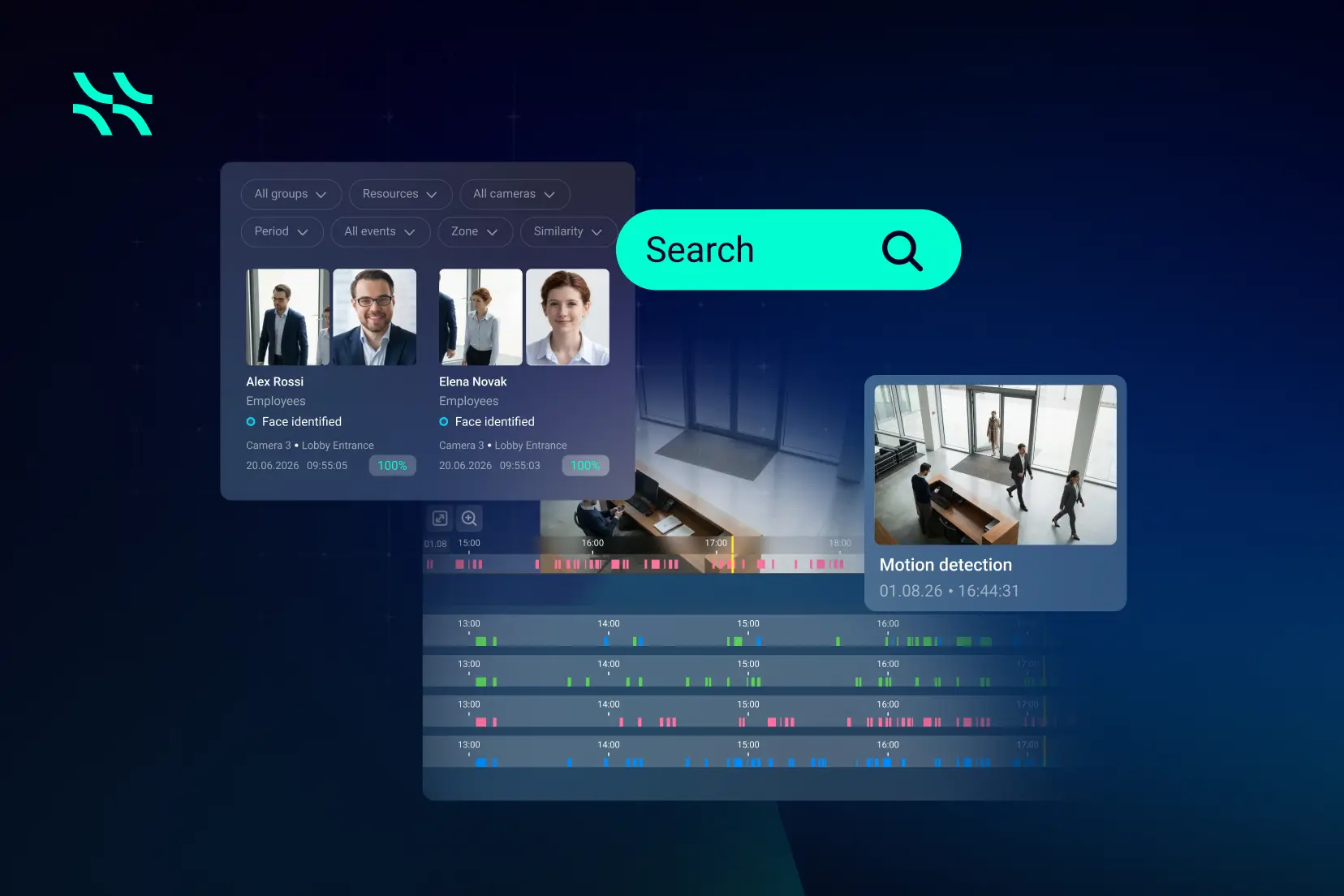
Aipix provides advanced search capabilities that allow users to narrow down recorded events using multiple parameters, including:
- Kamera — search within a specific camera or selected cameras.
- Lokalizacja — focus on a particular site or area.
- Date and time — define when the event occurred.
- Analytics type and event — search for particular detected events.
- Object category — on desktop, filter by person, vehicle, animal or unknown object.
Instead of manually reviewing an entire recording, the customer can combine these parameters to reduce the search area.
For example, a retail business investigating an incident could search for vehicle-related events at a particular location during a specific time period. A property manager might search for people detected in a certain area outside normal operating hours.
The value is not simply that the customer has more filters. The value is that the time required to find relevant evidence can be significantly reduced.
Analytics events directly on the video timeline
Search is only one part of the workflow.
Once the relevant recording is open, analytics events are highlighted directly on the player’s timeline. The customer can see where detected events occurred and quickly navigate to them.
Instead of manually moving through hours of footage, they can:
- identify an analytics event on the timeline;
- preview the event screenshot;
- jump directly to the corresponding moment with a click;
- examine the surrounding footage when additional context is required.
This creates a much more practical investigation workflow.
The customer is no longer simply watching archived video. They are using analytics to navigate through the archive and identify the parts of the recording that matter.
Why the combination of video archive and analytics matters
Archive and analytics have different roles, but their value increases when they are used together.
The archive provides historical data. It preserves video that can be reviewed after an event has already occurred.
Analytics adds structure to that data. It identifies objects and events and makes relevant moments easier to find.
Search connects the two. It allows users to retrieve specific information from large amounts of recorded footage.
Together, these capabilities transform the surveillance workflow:
Record → detect → search → find → investigate → act
This is particularly relevant for business customers, for whom video surveillance is often not just about security alerts.
From security monitoring to business process support
Once video becomes searchable, its potential applications extend beyond traditional incident response.
Different customer segments can use the same underlying capabilities for different purposes.
Video archive and analytics of Sprzedaż detaliczna
A retailer can use recorded video to investigate incidents, understand activity in specific areas or retrieve footage related to a particular time and event.
Logistyka i magazyny
Warehouse operators can search footage around loading zones, entrances or restricted areas and investigate events without reviewing entire recording periods.
Property management
Property managers can use analytics and archive search to investigate activity around entrances, parking areas and shared spaces.
Industrial facilities
Businesses can use event-based search to review activity around production or restricted areas and investigate incidents after they occur.
Commercial premises
Companies can retrieve footage associated with particular events, locations or object categories when reviewing security incidents or operational situations.
The exact use cases depend on the analytics scenarios available and the customer’s requirements. The important point is that the same video infrastructure can support more workflows when customers can efficiently retrieve information from the archive.
How providers can package the value of video archive and analytics
For telecom operators and ISPs, the commercial question is not only how to deliver these capabilities technically. It is how to turn them into a service customers understand and are willing to pay for.
A useful approach is to package the service around customer outcomes rather than individual technical features.
Instead of selling:
Cloud storage + video analytics + search
the provider can position the service around:
Find the video you need, investigate incidents faster and extract more value from your existing camera infrastructure.
The underlying features remain important, but the commercial proposition focuses on what customers can actually accomplish with them.
1. Extended archive as a paid service
Longer retention periods and larger storage capacity can form a natural upgrade path.
Different customers have different requirements. A residential subscriber may only need a relatively short retention period, while a business customer may need access to recordings over several weeks or months.
Providers can therefore create differentiated archive packages based on:
- storage capacity;
- retention period;
- liczba kamer;
- tryb nagrywania;
- access to advanced search and analytics.
This turns archive capacity from a technical parameter into a tiered service component.
For example, a basic plan could provide standard recording, while higher tiers could offer longer retention and additional investigation capabilities.
2. Video analytics as a VAS
Analytics can also become a standalone or premium value-added service.
Instead of including every analytics capability in the basic surveillance subscription, providers can create packages around specific customer needs.
Na przykład:
Basic Video
- live video;
- standard recording;
- archive access.
Advanced Video
- extended archive;
- analytics events;
- event search;
- advanced filters.
Business Video
- advanced analytics scenarios;
- smart search;
- extended retention;
- multiple cameras and locations;
- capabilities designed for investigation and operational use.
The exact packaging will depend on the provider’s market, infrastructure and customer segments.
The key principle is to create clear differences in customer value between service tiers.
3. Increasing ARPU through existing subscribers
One of the most accessible monetization paths is not necessarily acquiring completely new customers.
Providers can introduce additional capabilities to their existing video surveillance subscriber base.
A customer who already pays for connectivity and basic video surveillance may have a relatively low barrier to upgrading if the provider can demonstrate a clear additional benefit.
Na przykład:
Existing customer → standard surveillance → extended archive → advanced analytics → business-grade investigation capabilities
This creates an upselling path without requiring the provider to build an entirely new customer relationship.
It also allows operators to use their existing billing, customer management and service delivery infrastructure to commercialize additional video capabilities.
The key shift: sell access to information, not just video
The biggest commercial opportunity lies in changing how the service itself is presented.
Customers do not necessarily want more gigabytes of video.
They want to answer questions:
- What happened?
- When did it happen?
- Where did it happen?
- Who or what was involved?
- Which camera captured it?
- How can I find the relevant footage quickly?
- What happened immediately before and after the event?
Archive provides the historical evidence. Analytics helps structure it. Search makes that information accessible.
That is what allows a provider to move from selling video storage and access toward selling a tool for finding, analysing and investigating video data.
Wniosek
Video surveillance can generate significantly more value when archive and analytics are treated as complementary parts of one service rather than separate features.
For customers, the combination makes large volumes of recorded video easier to search and investigate.
For telecom operators and ISPs, it creates additional ways to structure the commercial offering: extended archive packages, analytics-based VAS, premium tiers and upselling to existing subscribers.
The result is a shift from a basic surveillance proposition — “store and watch your video” — toward a more valuable service: “find the information you need and use video to support your business processes.”
For providers looking to increase the commercial value of their video surveillance portfolio, the question is therefore not simply how much video they can store.
It is how easily their customers can turn that video into useful information.
Curious how these features can work for your business? Contact us for a demo and discuss ways to turn video analytics and archive into additional revenue.





 PL
PL  EN
EN  ES
ES  FR
FR  PT
PT